PROTESTS AT THE CONSUMER WANKSTRAVAANZA IN LAS VEGAS
http://www.takebackmytv.com/pages/breaking_news_ces?source=20090109Emgraphic
Friday, January 9, 2009


Wednesday, January 7, 2009
CEA LOSERS
For those caught up in the cybertarian consumerist phantasy, where better to learn how to recycle than the web site of the Consumer Electronics Association. Guess what? This will shock you. We need unaccountable private-sector self-regulation rather than anything democratic. You surprise me! Always so good to learn new ways to spin ancient, aged, falsehoods. You go, industry. We love you!
http://www.ce.org/AboutCEA/CEAInitiatives/3645.asp
http://www.ce.org/AboutCEA/CEAInitiatives/3645.asp
BBC ALSO GROWS UP
Tech fair offers greener vision
By Mark Ward
Technology correspondent, Las Vegas
In the near future, the "greenness" of a gadget will have a big influence on whether consumers will buy it, suggests research published as CES begins.
Consumers will soon look for more information about the environmental impact of a gadget and how it was made.
Published by the Consumer Electronics Association (CEA), it suggests people will pay more for truly green products.
But, it warned, consumers are very sceptical about the green claims made by hi-tech firms for their products.
"Green is becoming a purchasing factor," said Steve Koening, director of industry analysts at the CEA, which organises the giant annual Consumer Electronics Show.
CEA research found that consumers were becoming increasingly curious about how products are made and packaged, whether the processes involved were environmentally friendly and what provision is made to recycle a product once it became obsolete, he said.
"More than half are willing to pay a little more for 'green'," said Mr Koening. "22% said they were willing to pay up to 15% more for it."
But, he said, this conversion to environmental causes went hand-in-hand with a demand for more information about green gadgets.
More than 38% of those interviewed by the CEA said they were confused by green product claims and 58% wanted to know the specific attributes that prompted hi-tech firms to label their products green.
Many, said Mr Koening, were also very sceptical about the claims many manufacturer's made for their products.
Clear trends
The CEA research tried to identify key trends in consumer purchasing for the next four years. Alongside a desire for more green technologies went desires to do away with wires, have the internet embedded in everything and a wish to gain more control over gadgets.
One clear trend, said Mr Koening, was a demand for more products to be untethered and use wireless technologies wherever possible.
With this, he said, went a growing desire to be virtually tethered by the services and content available via these wireless, portable gadgets.
And, he said, whatever people are carrying around they definitely want it connected to the internet so they can keep in touch with friends and family or get at all the digital content they subscribe to, own or have generated themselves.
The final trend was a greater demand for control over gadgets, said Mr Koening. Instead of just relying on keyboard and mouse, consumers will want innovative ways, such as voice and gesture controls, that let them get more out of their hi-tech toys.
"It's about getting access to the ecosystem of products we have built up in our homes," he said.
Together the four trends look set to keep electronics hugely popular with consumers and help the industry buck the gloomy economic conditions, said Mr Koening.
'A necessity'
CEA economist Shawn DuBravac said: "Consumers are spending more of their money on technology purchases. It's helping bridge their personal and private lives.
"Consumer electronics are a necessity not a luxury; even though we have a background of economic catastrophe, enthusiasm for consumer electronics remains robust."
Tim Herbert, senior director of research for CEA, said although consumer spending on home electronics would not hit the highs seen in recent years it looked set to remain positive.
"We do expect a slowing in 2009 but, relative to other sectors, the consumer electronics industry will outperform," he said.
Growth in 2009 should hit 4.3%, said Mr Herbert, compared to 13.7% in 2008.
Over the last few years, said Mr Herbert, consumers have splashed out on the big expensive items such as large flat panel TVs and game consoles and now were hungry to do something with their purchases.
For instance, he said, in the games industry sales from software looked set to significantly outstrip sales of hardware such as consoles and handheld players in 2009 and beyond.
"It's important for the industry to understand how content and services interplays with the hardware side of the business," said Mr Herbert. "We have built an enormous installed base that will be hungry for content."
Story from BBC NEWS:
http://news.bbc.co.uk/go/pr/fr/-/2/hi/technology/7815219.stm
By Mark Ward
Technology correspondent, Las Vegas
In the near future, the "greenness" of a gadget will have a big influence on whether consumers will buy it, suggests research published as CES begins.
Consumers will soon look for more information about the environmental impact of a gadget and how it was made.
Published by the Consumer Electronics Association (CEA), it suggests people will pay more for truly green products.
But, it warned, consumers are very sceptical about the green claims made by hi-tech firms for their products.
"Green is becoming a purchasing factor," said Steve Koening, director of industry analysts at the CEA, which organises the giant annual Consumer Electronics Show.
CEA research found that consumers were becoming increasingly curious about how products are made and packaged, whether the processes involved were environmentally friendly and what provision is made to recycle a product once it became obsolete, he said.
"More than half are willing to pay a little more for 'green'," said Mr Koening. "22% said they were willing to pay up to 15% more for it."
But, he said, this conversion to environmental causes went hand-in-hand with a demand for more information about green gadgets.
More than 38% of those interviewed by the CEA said they were confused by green product claims and 58% wanted to know the specific attributes that prompted hi-tech firms to label their products green.
Many, said Mr Koening, were also very sceptical about the claims many manufacturer's made for their products.
Clear trends
The CEA research tried to identify key trends in consumer purchasing for the next four years. Alongside a desire for more green technologies went desires to do away with wires, have the internet embedded in everything and a wish to gain more control over gadgets.
One clear trend, said Mr Koening, was a demand for more products to be untethered and use wireless technologies wherever possible.
With this, he said, went a growing desire to be virtually tethered by the services and content available via these wireless, portable gadgets.
And, he said, whatever people are carrying around they definitely want it connected to the internet so they can keep in touch with friends and family or get at all the digital content they subscribe to, own or have generated themselves.
The final trend was a greater demand for control over gadgets, said Mr Koening. Instead of just relying on keyboard and mouse, consumers will want innovative ways, such as voice and gesture controls, that let them get more out of their hi-tech toys.
"It's about getting access to the ecosystem of products we have built up in our homes," he said.
Together the four trends look set to keep electronics hugely popular with consumers and help the industry buck the gloomy economic conditions, said Mr Koening.
'A necessity'
CEA economist Shawn DuBravac said: "Consumers are spending more of their money on technology purchases. It's helping bridge their personal and private lives.
"Consumer electronics are a necessity not a luxury; even though we have a background of economic catastrophe, enthusiasm for consumer electronics remains robust."
Tim Herbert, senior director of research for CEA, said although consumer spending on home electronics would not hit the highs seen in recent years it looked set to remain positive.
"We do expect a slowing in 2009 but, relative to other sectors, the consumer electronics industry will outperform," he said.
Growth in 2009 should hit 4.3%, said Mr Herbert, compared to 13.7% in 2008.
Over the last few years, said Mr Herbert, consumers have splashed out on the big expensive items such as large flat panel TVs and game consoles and now were hungry to do something with their purchases.
For instance, he said, in the games industry sales from software looked set to significantly outstrip sales of hardware such as consoles and handheld players in 2009 and beyond.
"It's important for the industry to understand how content and services interplays with the hardware side of the business," said Mr Herbert. "We have built an enormous installed base that will be hungry for content."
Story from BBC NEWS:
http://news.bbc.co.uk/go/pr/fr/-/2/hi/technology/7815219.stm
Tuesday, January 6, 2009
LOS ANGELES TIMES GROWS UP
Flat-screen TVs to face energy-efficiency rules in California
Starting in 2011, state regulators want retailers to sell only the most energy-efficient models of power hungry LCD and plasma sets. The industry opposes the new rules and warns of higher prices.
By Marc Lifsher
January 3, 2009
Reporting from Sacramento — That 52-inch, flat-screen television on the family room wall may have a terrific picture, but there's a big drawback: It's an energy hog.
State regulators are getting ready to curb the growing power gluttony of TV sets by drafting the nation's first rules requiring retailers to sell only the most energy-efficient models, starting in 2011.
The consumer electronics industry opposes the regulations, expected to pass in mid-2009, and claims that they could remove some TVs from store shelves and slightly boost sticker prices.
But the California Energy Commission is looking for ways to relieve the strain on the power grid. Officials say the standards, once fully in place, would reduce the state's annual energy needs by an amount equivalent to the power consumed by 86,400 homes.
During a peak viewing time when most sets are on, such as the Super Bowl, TVs in the state collectively suck up the equivalent of 40% of the power generated by the San Onofre nuclear power station running at full capacity. Televisions account for about 10% of the average Californian's monthly household electricity bill.
Some manufacturers could struggle to meet the new standards, particularly those that make plasma TVs. And the regulations could create a "gray" market, sending consumers intent on buying power-hungry models to Amazon.com and other Internet retailers based outside the state.
Sales of television sets are growing by 4 million a year, the vast majority of them flat-panels. LCD -- liquid crystal display -- sets use 43% more electricity, on average, than conventional tube TVs; larger models use proportionately more. Plasma TVs, which command a relatively small share of the market, need more than three times as much power as bulky, old-style sets.
The regulations would be phased in over two years, with a first tier taking effect on Jan. 1, 2011, and a more stringent, second tier on Jan. 1, 2013. Purchasers of Tier 1-compliant TVs would shave an average of $18.48 off their residential electric bill in the first year of ownership, the Energy Commission estimates. Tier 2 sets would save an additional $11.76 a year.
Over the years, California has pioneered similar tough standards for appliances, home insulation and food service equipment that eventually were adopted by the federal government and promoted to consumers with utility rebate programs.
"I think this is basically doable," said Energy Commission member Arthur Rosenfeld, an international leader for more than three decades in finding ways to save energy by boosting the efficiency of household appliances.
"Refrigerators and air conditioner manufacturers have grown up with standards, and, now, they are generally considered successes." he said. "But this is a new wrinkle for the TV industry."
Television manufacturers, wholesalers and national electronics chains stress that they are committed to making energy-frugal products and are moving as quickly as they can to respond to consumers' desire for energy-efficient televisions. But they aren't enthusiastic about the California plan, which they say will limit customer choice.
"The passion is correct. The proposal is not," said Doug Johnson, senior director of technology at the Consumer Electronics Assn. in Arlington, Va. "We can accomplish this without regulation as a result of innovation and voluntary approaches."
Mike McMaster, president of Wilshire Entertainment Inc., worries that a rush to impose TV efficiency standards "would be basically the end of our business." His locations in Thousand Oaks and Valencia employ 54 people and specialize in sales and installation of custom home theater systems centered on extremely large TVs.
"It would kill dealerships because people would buy on Amazon and have them shipped in and maybe not pay sales tax," he said. "If a customer wants a 12-cylinder car or a 60-inch plasma that uses this much energy, they're going to get it."
But shoppers waiting for a Best Buy store to open in Sacramento's post-Christmas fog showed little concern that some less efficient televisions might not be available two years from now.
"They should take them off the shelves," said Sam Ortega, a retired state worker. "We need to monitor our energy. It's good for everybody."
California should apply the same efficiency standards to televisions that it has used for the last 32 years with refrigerators and other products, argued Duane Larson, director of customer energy efficiency at Pacific Gas & Electric Co., the state's largest investor-owned utility, which serves customers from the Oregon border to the Tehachapi Mountains north of Los Angeles.
About two years ago, PG&E began thinking about applying energy-efficiency know-how to the consumer electronics industry, whose products, including computers, televisions and audio equipment, have become common in nearly every room of a house.
"We project that by 2010, one-quarter of the energy in a house will be used by consumer electronics," Larson said.
Increasing TV energy efficiency provides a triple benefit to California by boosting the economy, lowering electricity ratepayers' utility bills and helping the state meet its goals of reducing greenhouse gas emissions 15% by 2020, Larson said. "Every dollar spent on energy efficiency returns $2 in savings," he added.
Such savings should be encouraged, but not at the expense of businesses, large and small, that may see sales fall if they don't offer a wide variety of televisions, industry officials say.
The industry isn't sure how the regulations will affect it. The Consumer Electronics Assn. presented three scenarios to the commission, showing 10%, 20% and 30% drops in product availability and each of their potential financial effects.
If 30% of televisions fail to meet standards and can't be sold, California could lose $130 million in tax revenue and 15,800 jobs, Shawn DuBravac, an economist with the Consumer Electronics Assn., testified at a Dec. 15 Energy Commission workshop.
Rosenfeld was skeptical. DuBravac's numbers sounded "like arguments we heard from General Motors and Ford that SUVs are more profitable to make and create more jobs," he said. "There's a catch to it, as we all know."
What's more, Rosenfeld noted that a number of television makers already produce models that meet the proposed commission efficiency standards and that 87% of current stock complies with the planned 2011 threshold. That deadline may be pushed back a bit if the industry needs a little more time "to get used to the standards," he said.
More time might make the efficiency standards a lot more palatable, said Bob Smith, a training executive at AVAD, a Van Nuys wholesaler that supplies TVs and related equipment to independent installation contractors.
"I would hate to wake up one day and discover that 30% of my flagship products were no longer allowed to be sold." he said. "But I have no objection to regulations per se as long as there's enough lead time for manufacturers to meet the target."
Starting in 2011, state regulators want retailers to sell only the most energy-efficient models of power hungry LCD and plasma sets. The industry opposes the new rules and warns of higher prices.
By Marc Lifsher
January 3, 2009
Reporting from Sacramento — That 52-inch, flat-screen television on the family room wall may have a terrific picture, but there's a big drawback: It's an energy hog.
State regulators are getting ready to curb the growing power gluttony of TV sets by drafting the nation's first rules requiring retailers to sell only the most energy-efficient models, starting in 2011.
The consumer electronics industry opposes the regulations, expected to pass in mid-2009, and claims that they could remove some TVs from store shelves and slightly boost sticker prices.
But the California Energy Commission is looking for ways to relieve the strain on the power grid. Officials say the standards, once fully in place, would reduce the state's annual energy needs by an amount equivalent to the power consumed by 86,400 homes.
During a peak viewing time when most sets are on, such as the Super Bowl, TVs in the state collectively suck up the equivalent of 40% of the power generated by the San Onofre nuclear power station running at full capacity. Televisions account for about 10% of the average Californian's monthly household electricity bill.
Some manufacturers could struggle to meet the new standards, particularly those that make plasma TVs. And the regulations could create a "gray" market, sending consumers intent on buying power-hungry models to Amazon.com and other Internet retailers based outside the state.
Sales of television sets are growing by 4 million a year, the vast majority of them flat-panels. LCD -- liquid crystal display -- sets use 43% more electricity, on average, than conventional tube TVs; larger models use proportionately more. Plasma TVs, which command a relatively small share of the market, need more than three times as much power as bulky, old-style sets.
The regulations would be phased in over two years, with a first tier taking effect on Jan. 1, 2011, and a more stringent, second tier on Jan. 1, 2013. Purchasers of Tier 1-compliant TVs would shave an average of $18.48 off their residential electric bill in the first year of ownership, the Energy Commission estimates. Tier 2 sets would save an additional $11.76 a year.
Over the years, California has pioneered similar tough standards for appliances, home insulation and food service equipment that eventually were adopted by the federal government and promoted to consumers with utility rebate programs.
"I think this is basically doable," said Energy Commission member Arthur Rosenfeld, an international leader for more than three decades in finding ways to save energy by boosting the efficiency of household appliances.
"Refrigerators and air conditioner manufacturers have grown up with standards, and, now, they are generally considered successes." he said. "But this is a new wrinkle for the TV industry."
Television manufacturers, wholesalers and national electronics chains stress that they are committed to making energy-frugal products and are moving as quickly as they can to respond to consumers' desire for energy-efficient televisions. But they aren't enthusiastic about the California plan, which they say will limit customer choice.
"The passion is correct. The proposal is not," said Doug Johnson, senior director of technology at the Consumer Electronics Assn. in Arlington, Va. "We can accomplish this without regulation as a result of innovation and voluntary approaches."
Mike McMaster, president of Wilshire Entertainment Inc., worries that a rush to impose TV efficiency standards "would be basically the end of our business." His locations in Thousand Oaks and Valencia employ 54 people and specialize in sales and installation of custom home theater systems centered on extremely large TVs.
"It would kill dealerships because people would buy on Amazon and have them shipped in and maybe not pay sales tax," he said. "If a customer wants a 12-cylinder car or a 60-inch plasma that uses this much energy, they're going to get it."
But shoppers waiting for a Best Buy store to open in Sacramento's post-Christmas fog showed little concern that some less efficient televisions might not be available two years from now.
"They should take them off the shelves," said Sam Ortega, a retired state worker. "We need to monitor our energy. It's good for everybody."
California should apply the same efficiency standards to televisions that it has used for the last 32 years with refrigerators and other products, argued Duane Larson, director of customer energy efficiency at Pacific Gas & Electric Co., the state's largest investor-owned utility, which serves customers from the Oregon border to the Tehachapi Mountains north of Los Angeles.
About two years ago, PG&E began thinking about applying energy-efficiency know-how to the consumer electronics industry, whose products, including computers, televisions and audio equipment, have become common in nearly every room of a house.
"We project that by 2010, one-quarter of the energy in a house will be used by consumer electronics," Larson said.
Increasing TV energy efficiency provides a triple benefit to California by boosting the economy, lowering electricity ratepayers' utility bills and helping the state meet its goals of reducing greenhouse gas emissions 15% by 2020, Larson said. "Every dollar spent on energy efficiency returns $2 in savings," he added.
Such savings should be encouraged, but not at the expense of businesses, large and small, that may see sales fall if they don't offer a wide variety of televisions, industry officials say.
The industry isn't sure how the regulations will affect it. The Consumer Electronics Assn. presented three scenarios to the commission, showing 10%, 20% and 30% drops in product availability and each of their potential financial effects.
If 30% of televisions fail to meet standards and can't be sold, California could lose $130 million in tax revenue and 15,800 jobs, Shawn DuBravac, an economist with the Consumer Electronics Assn., testified at a Dec. 15 Energy Commission workshop.
Rosenfeld was skeptical. DuBravac's numbers sounded "like arguments we heard from General Motors and Ford that SUVs are more profitable to make and create more jobs," he said. "There's a catch to it, as we all know."
What's more, Rosenfeld noted that a number of television makers already produce models that meet the proposed commission efficiency standards and that 87% of current stock complies with the planned 2011 threshold. That deadline may be pushed back a bit if the industry needs a little more time "to get used to the standards," he said.
More time might make the efficiency standards a lot more palatable, said Bob Smith, a training executive at AVAD, a Van Nuys wholesaler that supplies TVs and related equipment to independent installation contractors.
"I would hate to wake up one day and discover that 30% of my flagship products were no longer allowed to be sold." he said. "But I have no objection to regulations per se as long as there's enough lead time for manufacturers to meet the target."
Monday, January 5, 2009
thanks ricky!
Rick Maxwell sent this along:
Interesting story about effects of carbon trading on poorest of poor ragpickers in India.
From Multinational Monitor. vol 29, number 3. Nov/Dec 2008. pp. 23-26. (great issue by the way--also available online)
Carbon Market Fundamentalism
by Daphne Wysham
The waste-pickers of Delhi may soon rank among the world’s endangered species if carbon markets continue their rise. Now numbering in the tens if not hundreds of thousands, waste-pickers have plied the garbage of Delhi’s streets for decades. A disturbing spectacle, often including women and children in their ranks, they nonetheless provide a vital service: recycling. In a country like India, paper, plastic and metals are an increasingly valuable commodity. And for slum-dwellers, this may be their only source of income. And so they join the cows and dogs in a daily forage through garbage by the side of road, searching for plastic, paper, metals — anything that can be turned into cash.
Bharati Chaturvedi, director and co-founder of Chintan, a small non-governmental organization (NGO) servicing India’s waste-pickers, claims that more than 1 percent of Delhi’s population is engaged in waste-picking — a significant source of revenue for the poorest — and that they recycle 9 percent to 59 percent of all of the waste generated in the city. “These waste-pickers are providing a public service — for free,” Chaturvedi says.
But a waste incinerator now proposed in Timarpur, a suburb of Delhi, may change all that. Like other incinerators, this one will generate cancer-causing dioxins, mercury, and other heavy metals and persistent organic pollutants. What’s new and different about this particular waste incinerator: It will generate carbon credits under the Clean Development Mechanism (CDM).
The CDM was originally established under the Kyoto Protocol, the climate change treaty, to address the need to provide new aid to developing countries to acquire and implement new clean energy technologies and projects. Its intent was also to provide a vehicle for development. However, critics say, the CDM is rapidly devolving into a subsidy for some of the dirtiest industries in the Global South and an excuse for inaction in cutting the significant greenhouse gas emissions by developed countries. Dirty industries and banks are growing rich on the schemes: The World Bank, for example, is becoming a major broker of many of them, charging a 13 percent commission on all of the carbon trades it brokers.
The Timarpur incinerator may be the first in a series of incinerators to benefit from the global carbon market, despite India’s informal and effective recycling industry and generally hostile posture toward incinerators. Gopal Krishna, a public health researcher at Jawaharlal Nehru University, New Delhi, had succeeded in dissuading government officials from accepting other proposals from Australian and Danish incinerator companies in Delhi, based on public health concerns. “We had managed to stop half a dozen of these dubious projects in the past,” says Krishna. “But this time around, in the name of carbon credits, fraudulent claims are being made with impunity.”
In addition to Krishna’s public health arguments, there is another reason incinerators have never gotten off the ground in Delhi: “Delhi’s garbage doesn’t have enough burnable matter,” says Neil Tangri, Waste and Climate Change Campaign Director for the Global Alliance for Incinerator Alternatives (GAIA). “It tends to be too wet, containing too much ash and sand, and non-combustible inert materials.” In other words, not enough combustible products like plastic and paper, thanks in large part to the diligent waste-pickers.
But today, with an incinerator contract looming on the horizon, and with it the potential for millions of dollars in revenue from the global carbon market, the political dynamic has changed. These waste-pickers are being harassed by dump managers and actively denied access to the dry, high-calorie items the incinerator will devour.
“They are effectively denying a livelihood to the poorest of the poor in setting up this incinerator,” says Chaturvedi. “To take that miserable existence away, it’s criminal. And now we’re seeing skyrocketing food prices in India. What will these people do? Huge local skills in recycling are now being wiped out, skills essential for a sustainable society.”
An additional problem with the incinerator is what to do with the fly ash left over. “I’ve been all over India,” says Patricia Costner, science adviser to GAIA and the International POPS Elimination Network. “I know what happens to incinerator ash. Most of it ends up by the side of the road. There are no engineered landfills in India. Fly ash and bottom ash is required to be managed very carefully in most countries, but in India, they simply do not have the infrastructure to do that.”
Improper disposal of incinerator waste isn’t the only problem: “When waste pickers are denied access to the waste stream, they go through the ash looking for metal, the only substance to survive incineration intact,” says GAIA’s Tangri. “I’ve seen people thigh deep picking through incinerator ash for metals. You’re using the human body as a toxic absorber — you’re basically spoon-feeding it to these people.”
Despite doubts raised by the Indian government and Supreme Court as to the advisability of incinerators in India, one of the most avid proponents of these carbon credit schemes is India’s former minister of environment and forests, Rajesh Kumar Sethi. Sethi was recently elected chair of the executive board of the CDM, the supervisory body that determines which projects qualify for CDM credits. “It would be impossible for [Sethi] to question any project that has been incorrectly cleared by the Central Pollution Control Board, a board that comes directly under the ministry he used to direct,” says Krishna.
Carbon Trading 101
Little understood by all but a few insiders, carbon trading was established under the Kyoto Protocol and involves two types of credits. There are “offsets” and “allowances.” Allowances are the limited number of government-allocated credits that are either auctioned or given away to certain industries within a developed country that has signed on to the Kyoto Protocol. One allowance equals one ton of carbon dioxide. Polluters that emit more than they are allowed must buy enough carbon credits within their country or from other designated developed countries (grouped as “Annex B” countries in the Kyoto Protocol) to match their allocated greenhouse gas emission levels. Thus, Company A may have exceeded its permitted carbon allowances by 100 tons, and so buys from Company B, which has managed to reduce its emissions by 100 tons carbon. The theory is: The overall cap is the same regardless of the trade, and the invisible hand of the market allows emissions reductions to occur with greater flexibility, less “command and control” and produces a “win-win” scenario for everyone involved.
The Clean Development Mechanism also permits carbon allowances to be traded between Annex B countries and developing countries — countries that are signatory to the Kyoto Protocol but don’t yet have limits on their greenhouse gas emissions. The problem here is that trading under the CDM is thus occurring between a set of countries that have an overall cap on their emissions, Annex B countries, and a set of countries that have no caps on their emissions, developing countries. In order to avoid bogus emissions credits being sold by developing countries to Annex B countries, the UNFCCC decided that carbon credits would be issued under the CDM only if they were “additional” — or “not business as usual.” This concept of additionality, which requires the proof of a counter-factual, has been all but impossible to verify.
The CDM is a subset of an overall category of carbon trading, “offsets,” which critics claim do not constitute actual emissions reductions. There are two primary markets for carbon offsets: the voluntary market and the so-called “compliance” market of the CDM. The voluntary carbon offset market — much like the “compliance” one — offers up for sale the replacement of a climate “bad” with a climate “good.” So, for example, if I am going to fly across the country, I will “offset” the carbon emissions from the flight by investing in a tree planting program. Greenhouse gas emissions may rise from my transcontinental flight; however, I can feel better knowing that I’ve “offset” my flight by investing in a tree farm that will absorb a quantity of carbon roughly equivalent to my flight. These voluntary offsets tend to be poorly regulated and therefore cheaper than compliance-based offsets, which have more rigorous — but still insufficient, to many — regulatory requirements.
Even the “Certified Emissions Reductions” sold under the CDM seem a far cry from actual “emissions reductions.” In fact, according to David Victor of Stanford University, as many as two thirds of the credits being produced by the CDM from projects in developing countries are not resulting in any emissions reductions. Victor and Michael Wara, a law professor at Stanford, found in an April 2008 paper that virtually all of the hydropower, natural gas and wind projects in China are applying for CDM credits. Yet, clearly, China could not make the argument that none of these projects would have gone forward without CDM credits — a key criterion for support under the CDM.
A separate study published by International Rivers argues that nearly three quarters of all registered CDM projects were complete at the time of approval, suggesting that the requirement that project developers could not have gone forward without the “additional” source of CDM funds is being routinely waived.
Even compliance-based offsets, such as those sold under the CDM, are proving highly problematic. With the price of offsets remaining quite low, the most common form of offsets involves large dams, the destruction of industrial pollutants and the combustion of landfill methane — the “low-hanging fruit” in a carbon market where the price of carbon has hovered at very low levels.
Policy Goals Achieved? Not Really
The same deregulatory fervor that is playing out in the bankruptcy of Wall Street banks, credit card companies and derivatives traders brought the theory of carbon trading: Open up the free markets — in this case, the newly minted market in carbon — eliminate regulatory interventions such as carbon taxes or precise standards for polluters, and the market will seek out the most efficient means of achieving the same emissions reductions goals.
“None of us is clever enough to work out what is the best way to tackle climate change,” states Matthew Whittell of Climate Exchange, a company that owns the European Climate Exchange and the Chicago Climate Exchange. “But, if we have a global carbon price, the market sorts it out.”
However, early evidence suggests that what is being sorted out is just how much more consumers will pay for an increase in greenhouse gas emissions. The European Union Emissions Trading Scheme (EU ETS), has thus far resulted in a rise in greenhouse gas emissions while profits have skyrocketed for utilities and energy traders. In a powerpoint presentation entitled, “Citigroup Analysis of the Impact of the EU Carbon Market on European Utilities,” Citigroup’s Head of European Utility Research Peter Atherton summarizes the EU ETS this way: “All generation-based utilities: winners. Coal and nuclear generators: Biggest winners. Hedge funds and energy traders: even bigger winners. Losers?? Herm … consumers!”
He goes on to note: “Have policy goals been achieved? Prices up. Emissions up. Profits up. … So, not really.”
Emissions have risen under the EU ETS because companies essentially fudged their numbers at the outset, claiming they would emit more than they expected to, so they would have an excess of permits to sell. Others were equally crafty, and the price of carbon plummeted.
A similar fiasco is unfolding in the newly minted Regional Greenhouse Gas Initiative (RGGI) an emissions trading scheme for U.S. northeastern states launched in September 2008. The RGGI initiative involves nine states aiming to provide a domestic pilot “cap and trade” market for carbon. Early results from the RGGI initiative, like the EU ETS, show evidence of over-allocation of permits to pollute and a concomitant drop in the price of carbon, as demand for carbon trades proved virtually non-existent.
Recently, the Chicago Climate Exchange (CCX), which claims to be “North America’s only and the world’s first global marketplace for integrating voluntary legally binding emissions reductions with emissions trading and offsets for all six greenhouse gases,” saw its shares drop in value by almost 80 percent from a high of $7.50 in June to a low of $1.50 on October 23, 2008. Bankrupt Lehman Brothers was among those “distressed sellers” of CCX shares that drove down the price of carbon on the U.S. markets to one of its lowest levels since carbon markets were launched in 2003. The price dropped further after a Wall Street Journal article questioned whether carbon credits trading on the CCX represent emission cuts that would not have otherwise have happened.
“We Need Direct Action”
Larry Lohmann of the UK-based think tank The Corner House, and author of the book, Carbon Trading, argues that advocates of carbon trading overlook two critical things: first, the poor are often paying the price for the vast profits of carbon traders, while seeing few benefits; and, second, the most direct solution to climate chaos is not part of the equation — namely, reorganizing society so that fossil fuels can be left in the ground while the planet’s remaining forests are preserved and even enlarged.
As carbon markets gain steam internationally, forest carbon credits are now opening up as a new arena for investment: A country’s entire forests are now up for sale as offsets for continued pollution by wealthy countries. And once again, it is the World Bank that is leading the way. Under its new “Forest Investment Fund” and “Forest Carbon Partnership Facility,” the Bank is preparing to show the world how to “scale up” forests as offsets — selling carbon from individual tracts of forests, or even an entire country’s forest reserves — as “offsets” for Northern countries to purchase, in lieu of reducing their own emissions at home.
Yet, in violation of the UN Declaration on the Rights of Indigenous Peoples, indigenous peoples who inhabit and have preserved these forests for generations, are often the last to be consulted on these schemes. For many of them, land rights, rather than cash for carbon credits, are a higher priority in the struggle for autonomy and the right to control their ancestral lands.
“Using market-based systems to privatize our land, forests and now to commodify the atmosphere is not a sustainable solution,” says Tom Goldtooth, executive director of the Indigenous Environmental Network.
Despite the early evidence of flaws in carbon markets, few environmental organizations are willing to be critical of this approach. All current legislative proposals being advanced on Capitol Hill to address climate change include some form of “cap and trade,” another name for carbon trading.
President-elect Barack Obama supports the idea of a “cap and auction” market-based approach to solve the climate crisis. Yet what few politicians mention, is that if the various market mechanisms for addressing climate change — the so-called “cap and trade” approach, where most pollution permits are given away to polluters, or the “cap and auction” approach, where pollution permits are auctioned — move forward nationally, they will eventually open up to the global market in carbon offsets, including the highly problematic CDM.
Representatives Jay Inslee, D-Washington, Ed Markey, D-Massachusetts, and Henry Waxman, D-California, are among the few Members of Congress to advance principles and legislation that recognize the problematic nature of “carbon offsets,” such as those being advanced by the World Bank and some environmental organizations. “We have to be very critical of any mechanisms involving offsets,” Inslee says. “We have to assure in the real world — not the abstract world — that you get something for your money. We do not have that right now. Until we do, I don’t think the offsets should be something you get credit for.”
S. David Freeman, former energy advisor to Presidents Carter, Nixon and Kennedy, and former director of the Tennessee Valley Authority, goes one step further: “If we’re on death row, as Al Gore and others say we are, then we need to take direct action, and I think the most important form of direct action is deciding from this day forward it’s all going to be renewable. Why don’t we outlaw new coal and nuclear plants?
“In World War II, we told the car companies to stop making cars and to start making tanks and airplanes and we won the war in less time than we’ve been in Iraq. When we have a flu epidemic, the government goes out and buys vaccines. Yet, now, with the climate crisis, there seems to be a reluctance in this country to act collectively through its government.”
Tom Picken, the Head of International Climate for Friends of the Earth-UK, puts it this way: “It is absolutely clear that there is no ‘spare’ [carbon dioxide] ‘in the system’ and therefore no ‘spare’ [carbon dioxide] to trade. If there is no spare [carbon dioxide] to trade, then this poses a pretty fundamental challenge to the means available to achieve emissions reductions — that there cannot be any more offsetting of any form. To do so is downright dangerous, in my view, and seems to me to be based on neoliberal economic fundamentalism rather than being environmentally and socially informed.”
Daphne Wysham is the director of the Sustainable Energy and Economy Network (SEEN) at the Institute for Policy Studies.
pic snipped
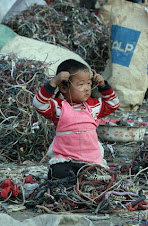
Above: A rag-picker in Delhi, India.
World Bank: Climate Profiteer
grey box:
The World Bank is perhaps the best example of how one institution can use carbon trading for profit, while continuing to finance projects that make the climate grow more unstable. The Bank’s growing number of carbon funds were the subject of a recent report by Janet Redman, a researcher with the Sustainable Energy and Economy Network, a project of the Washington, D.C.-based Institute for Policy Studies. That report, “World Bank: Climate Profiteer,” found that the World Bank was charging a 13 percent commission on its more than $2 billion in carbon trades, while continuing to support fossil fuels. The report found that these World Bank carbon trade projects show little evidence of actual emissions reductions: Of the 83 active World Bank projects found in the Bank’s online project database, only nine have delivered Certified Emissions Reductions (CERs). The vast majority of these CERs came from a single industrial chemical project in China. That chemical project — the destruction of hydrochlorofluorocarbons, or HCFCs — is highly controversial as it potentially pits the Montreal Protocol to Control Substances that Deplete the Ozone Layer against the UN Framework Convention on Climate Change, by making it hugely profitable to destroy HCFCs, thereby potentially creating perverse incentives to continue to produce them.
Other key findings of the report include:
* To date, less than 10 percent of all the funds flowing through the World Bank’s carbon trust funds are going to support clean, renewable energy, defined as wind, geothermal solar and hydro-electricity power plants with a generating capacity of 10 megawatts or less.
* The bulk of the World Bank’s carbon finance portfolio (75 percent to 85 percent) has been directed to carbon trades involving the coal, chemical, iron and steel industries.
*
The World Bank Group is experimenting in the carbon market, without taking significant risks, knowing that projects with little added value can be readily dumped — for a profit — into the voluntary carbon market, a market that is entirely self-regulated.
- D.W.
Interesting story about effects of carbon trading on poorest of poor ragpickers in India.
From Multinational Monitor. vol 29, number 3. Nov/Dec 2008. pp. 23-26. (great issue by the way--also available online)
Carbon Market Fundamentalism
by Daphne Wysham
The waste-pickers of Delhi may soon rank among the world’s endangered species if carbon markets continue their rise. Now numbering in the tens if not hundreds of thousands, waste-pickers have plied the garbage of Delhi’s streets for decades. A disturbing spectacle, often including women and children in their ranks, they nonetheless provide a vital service: recycling. In a country like India, paper, plastic and metals are an increasingly valuable commodity. And for slum-dwellers, this may be their only source of income. And so they join the cows and dogs in a daily forage through garbage by the side of road, searching for plastic, paper, metals — anything that can be turned into cash.
Bharati Chaturvedi, director and co-founder of Chintan, a small non-governmental organization (NGO) servicing India’s waste-pickers, claims that more than 1 percent of Delhi’s population is engaged in waste-picking — a significant source of revenue for the poorest — and that they recycle 9 percent to 59 percent of all of the waste generated in the city. “These waste-pickers are providing a public service — for free,” Chaturvedi says.
But a waste incinerator now proposed in Timarpur, a suburb of Delhi, may change all that. Like other incinerators, this one will generate cancer-causing dioxins, mercury, and other heavy metals and persistent organic pollutants. What’s new and different about this particular waste incinerator: It will generate carbon credits under the Clean Development Mechanism (CDM).
The CDM was originally established under the Kyoto Protocol, the climate change treaty, to address the need to provide new aid to developing countries to acquire and implement new clean energy technologies and projects. Its intent was also to provide a vehicle for development. However, critics say, the CDM is rapidly devolving into a subsidy for some of the dirtiest industries in the Global South and an excuse for inaction in cutting the significant greenhouse gas emissions by developed countries. Dirty industries and banks are growing rich on the schemes: The World Bank, for example, is becoming a major broker of many of them, charging a 13 percent commission on all of the carbon trades it brokers.
The Timarpur incinerator may be the first in a series of incinerators to benefit from the global carbon market, despite India’s informal and effective recycling industry and generally hostile posture toward incinerators. Gopal Krishna, a public health researcher at Jawaharlal Nehru University, New Delhi, had succeeded in dissuading government officials from accepting other proposals from Australian and Danish incinerator companies in Delhi, based on public health concerns. “We had managed to stop half a dozen of these dubious projects in the past,” says Krishna. “But this time around, in the name of carbon credits, fraudulent claims are being made with impunity.”
In addition to Krishna’s public health arguments, there is another reason incinerators have never gotten off the ground in Delhi: “Delhi’s garbage doesn’t have enough burnable matter,” says Neil Tangri, Waste and Climate Change Campaign Director for the Global Alliance for Incinerator Alternatives (GAIA). “It tends to be too wet, containing too much ash and sand, and non-combustible inert materials.” In other words, not enough combustible products like plastic and paper, thanks in large part to the diligent waste-pickers.
But today, with an incinerator contract looming on the horizon, and with it the potential for millions of dollars in revenue from the global carbon market, the political dynamic has changed. These waste-pickers are being harassed by dump managers and actively denied access to the dry, high-calorie items the incinerator will devour.
“They are effectively denying a livelihood to the poorest of the poor in setting up this incinerator,” says Chaturvedi. “To take that miserable existence away, it’s criminal. And now we’re seeing skyrocketing food prices in India. What will these people do? Huge local skills in recycling are now being wiped out, skills essential for a sustainable society.”
An additional problem with the incinerator is what to do with the fly ash left over. “I’ve been all over India,” says Patricia Costner, science adviser to GAIA and the International POPS Elimination Network. “I know what happens to incinerator ash. Most of it ends up by the side of the road. There are no engineered landfills in India. Fly ash and bottom ash is required to be managed very carefully in most countries, but in India, they simply do not have the infrastructure to do that.”
Improper disposal of incinerator waste isn’t the only problem: “When waste pickers are denied access to the waste stream, they go through the ash looking for metal, the only substance to survive incineration intact,” says GAIA’s Tangri. “I’ve seen people thigh deep picking through incinerator ash for metals. You’re using the human body as a toxic absorber — you’re basically spoon-feeding it to these people.”
Despite doubts raised by the Indian government and Supreme Court as to the advisability of incinerators in India, one of the most avid proponents of these carbon credit schemes is India’s former minister of environment and forests, Rajesh Kumar Sethi. Sethi was recently elected chair of the executive board of the CDM, the supervisory body that determines which projects qualify for CDM credits. “It would be impossible for [Sethi] to question any project that has been incorrectly cleared by the Central Pollution Control Board, a board that comes directly under the ministry he used to direct,” says Krishna.
Carbon Trading 101
Little understood by all but a few insiders, carbon trading was established under the Kyoto Protocol and involves two types of credits. There are “offsets” and “allowances.” Allowances are the limited number of government-allocated credits that are either auctioned or given away to certain industries within a developed country that has signed on to the Kyoto Protocol. One allowance equals one ton of carbon dioxide. Polluters that emit more than they are allowed must buy enough carbon credits within their country or from other designated developed countries (grouped as “Annex B” countries in the Kyoto Protocol) to match their allocated greenhouse gas emission levels. Thus, Company A may have exceeded its permitted carbon allowances by 100 tons, and so buys from Company B, which has managed to reduce its emissions by 100 tons carbon. The theory is: The overall cap is the same regardless of the trade, and the invisible hand of the market allows emissions reductions to occur with greater flexibility, less “command and control” and produces a “win-win” scenario for everyone involved.
The Clean Development Mechanism also permits carbon allowances to be traded between Annex B countries and developing countries — countries that are signatory to the Kyoto Protocol but don’t yet have limits on their greenhouse gas emissions. The problem here is that trading under the CDM is thus occurring between a set of countries that have an overall cap on their emissions, Annex B countries, and a set of countries that have no caps on their emissions, developing countries. In order to avoid bogus emissions credits being sold by developing countries to Annex B countries, the UNFCCC decided that carbon credits would be issued under the CDM only if they were “additional” — or “not business as usual.” This concept of additionality, which requires the proof of a counter-factual, has been all but impossible to verify.
The CDM is a subset of an overall category of carbon trading, “offsets,” which critics claim do not constitute actual emissions reductions. There are two primary markets for carbon offsets: the voluntary market and the so-called “compliance” market of the CDM. The voluntary carbon offset market — much like the “compliance” one — offers up for sale the replacement of a climate “bad” with a climate “good.” So, for example, if I am going to fly across the country, I will “offset” the carbon emissions from the flight by investing in a tree planting program. Greenhouse gas emissions may rise from my transcontinental flight; however, I can feel better knowing that I’ve “offset” my flight by investing in a tree farm that will absorb a quantity of carbon roughly equivalent to my flight. These voluntary offsets tend to be poorly regulated and therefore cheaper than compliance-based offsets, which have more rigorous — but still insufficient, to many — regulatory requirements.
Even the “Certified Emissions Reductions” sold under the CDM seem a far cry from actual “emissions reductions.” In fact, according to David Victor of Stanford University, as many as two thirds of the credits being produced by the CDM from projects in developing countries are not resulting in any emissions reductions. Victor and Michael Wara, a law professor at Stanford, found in an April 2008 paper that virtually all of the hydropower, natural gas and wind projects in China are applying for CDM credits. Yet, clearly, China could not make the argument that none of these projects would have gone forward without CDM credits — a key criterion for support under the CDM.
A separate study published by International Rivers argues that nearly three quarters of all registered CDM projects were complete at the time of approval, suggesting that the requirement that project developers could not have gone forward without the “additional” source of CDM funds is being routinely waived.
Even compliance-based offsets, such as those sold under the CDM, are proving highly problematic. With the price of offsets remaining quite low, the most common form of offsets involves large dams, the destruction of industrial pollutants and the combustion of landfill methane — the “low-hanging fruit” in a carbon market where the price of carbon has hovered at very low levels.
Policy Goals Achieved? Not Really
The same deregulatory fervor that is playing out in the bankruptcy of Wall Street banks, credit card companies and derivatives traders brought the theory of carbon trading: Open up the free markets — in this case, the newly minted market in carbon — eliminate regulatory interventions such as carbon taxes or precise standards for polluters, and the market will seek out the most efficient means of achieving the same emissions reductions goals.
“None of us is clever enough to work out what is the best way to tackle climate change,” states Matthew Whittell of Climate Exchange, a company that owns the European Climate Exchange and the Chicago Climate Exchange. “But, if we have a global carbon price, the market sorts it out.”
However, early evidence suggests that what is being sorted out is just how much more consumers will pay for an increase in greenhouse gas emissions. The European Union Emissions Trading Scheme (EU ETS), has thus far resulted in a rise in greenhouse gas emissions while profits have skyrocketed for utilities and energy traders. In a powerpoint presentation entitled, “Citigroup Analysis of the Impact of the EU Carbon Market on European Utilities,” Citigroup’s Head of European Utility Research Peter Atherton summarizes the EU ETS this way: “All generation-based utilities: winners. Coal and nuclear generators: Biggest winners. Hedge funds and energy traders: even bigger winners. Losers?? Herm … consumers!”
He goes on to note: “Have policy goals been achieved? Prices up. Emissions up. Profits up. … So, not really.”
Emissions have risen under the EU ETS because companies essentially fudged their numbers at the outset, claiming they would emit more than they expected to, so they would have an excess of permits to sell. Others were equally crafty, and the price of carbon plummeted.
A similar fiasco is unfolding in the newly minted Regional Greenhouse Gas Initiative (RGGI) an emissions trading scheme for U.S. northeastern states launched in September 2008. The RGGI initiative involves nine states aiming to provide a domestic pilot “cap and trade” market for carbon. Early results from the RGGI initiative, like the EU ETS, show evidence of over-allocation of permits to pollute and a concomitant drop in the price of carbon, as demand for carbon trades proved virtually non-existent.
Recently, the Chicago Climate Exchange (CCX), which claims to be “North America’s only and the world’s first global marketplace for integrating voluntary legally binding emissions reductions with emissions trading and offsets for all six greenhouse gases,” saw its shares drop in value by almost 80 percent from a high of $7.50 in June to a low of $1.50 on October 23, 2008. Bankrupt Lehman Brothers was among those “distressed sellers” of CCX shares that drove down the price of carbon on the U.S. markets to one of its lowest levels since carbon markets were launched in 2003. The price dropped further after a Wall Street Journal article questioned whether carbon credits trading on the CCX represent emission cuts that would not have otherwise have happened.
“We Need Direct Action”
Larry Lohmann of the UK-based think tank The Corner House, and author of the book, Carbon Trading, argues that advocates of carbon trading overlook two critical things: first, the poor are often paying the price for the vast profits of carbon traders, while seeing few benefits; and, second, the most direct solution to climate chaos is not part of the equation — namely, reorganizing society so that fossil fuels can be left in the ground while the planet’s remaining forests are preserved and even enlarged.
As carbon markets gain steam internationally, forest carbon credits are now opening up as a new arena for investment: A country’s entire forests are now up for sale as offsets for continued pollution by wealthy countries. And once again, it is the World Bank that is leading the way. Under its new “Forest Investment Fund” and “Forest Carbon Partnership Facility,” the Bank is preparing to show the world how to “scale up” forests as offsets — selling carbon from individual tracts of forests, or even an entire country’s forest reserves — as “offsets” for Northern countries to purchase, in lieu of reducing their own emissions at home.
Yet, in violation of the UN Declaration on the Rights of Indigenous Peoples, indigenous peoples who inhabit and have preserved these forests for generations, are often the last to be consulted on these schemes. For many of them, land rights, rather than cash for carbon credits, are a higher priority in the struggle for autonomy and the right to control their ancestral lands.
“Using market-based systems to privatize our land, forests and now to commodify the atmosphere is not a sustainable solution,” says Tom Goldtooth, executive director of the Indigenous Environmental Network.
Despite the early evidence of flaws in carbon markets, few environmental organizations are willing to be critical of this approach. All current legislative proposals being advanced on Capitol Hill to address climate change include some form of “cap and trade,” another name for carbon trading.
President-elect Barack Obama supports the idea of a “cap and auction” market-based approach to solve the climate crisis. Yet what few politicians mention, is that if the various market mechanisms for addressing climate change — the so-called “cap and trade” approach, where most pollution permits are given away to polluters, or the “cap and auction” approach, where pollution permits are auctioned — move forward nationally, they will eventually open up to the global market in carbon offsets, including the highly problematic CDM.
Representatives Jay Inslee, D-Washington, Ed Markey, D-Massachusetts, and Henry Waxman, D-California, are among the few Members of Congress to advance principles and legislation that recognize the problematic nature of “carbon offsets,” such as those being advanced by the World Bank and some environmental organizations. “We have to be very critical of any mechanisms involving offsets,” Inslee says. “We have to assure in the real world — not the abstract world — that you get something for your money. We do not have that right now. Until we do, I don’t think the offsets should be something you get credit for.”
S. David Freeman, former energy advisor to Presidents Carter, Nixon and Kennedy, and former director of the Tennessee Valley Authority, goes one step further: “If we’re on death row, as Al Gore and others say we are, then we need to take direct action, and I think the most important form of direct action is deciding from this day forward it’s all going to be renewable. Why don’t we outlaw new coal and nuclear plants?
“In World War II, we told the car companies to stop making cars and to start making tanks and airplanes and we won the war in less time than we’ve been in Iraq. When we have a flu epidemic, the government goes out and buys vaccines. Yet, now, with the climate crisis, there seems to be a reluctance in this country to act collectively through its government.”
Tom Picken, the Head of International Climate for Friends of the Earth-UK, puts it this way: “It is absolutely clear that there is no ‘spare’ [carbon dioxide] ‘in the system’ and therefore no ‘spare’ [carbon dioxide] to trade. If there is no spare [carbon dioxide] to trade, then this poses a pretty fundamental challenge to the means available to achieve emissions reductions — that there cannot be any more offsetting of any form. To do so is downright dangerous, in my view, and seems to me to be based on neoliberal economic fundamentalism rather than being environmentally and socially informed.”
Daphne Wysham is the director of the Sustainable Energy and Economy Network (SEEN) at the Institute for Policy Studies.
pic snipped
Above: A rag-picker in Delhi, India.
World Bank: Climate Profiteer
grey box:
The World Bank is perhaps the best example of how one institution can use carbon trading for profit, while continuing to finance projects that make the climate grow more unstable. The Bank’s growing number of carbon funds were the subject of a recent report by Janet Redman, a researcher with the Sustainable Energy and Economy Network, a project of the Washington, D.C.-based Institute for Policy Studies. That report, “World Bank: Climate Profiteer,” found that the World Bank was charging a 13 percent commission on its more than $2 billion in carbon trades, while continuing to support fossil fuels. The report found that these World Bank carbon trade projects show little evidence of actual emissions reductions: Of the 83 active World Bank projects found in the Bank’s online project database, only nine have delivered Certified Emissions Reductions (CERs). The vast majority of these CERs came from a single industrial chemical project in China. That chemical project — the destruction of hydrochlorofluorocarbons, or HCFCs — is highly controversial as it potentially pits the Montreal Protocol to Control Substances that Deplete the Ozone Layer against the UN Framework Convention on Climate Change, by making it hugely profitable to destroy HCFCs, thereby potentially creating perverse incentives to continue to produce them.
Other key findings of the report include:
* To date, less than 10 percent of all the funds flowing through the World Bank’s carbon trust funds are going to support clean, renewable energy, defined as wind, geothermal solar and hydro-electricity power plants with a generating capacity of 10 megawatts or less.
* The bulk of the World Bank’s carbon finance portfolio (75 percent to 85 percent) has been directed to carbon trades involving the coal, chemical, iron and steel industries.
*
The World Bank Group is experimenting in the carbon market, without taking significant risks, knowing that projects with little added value can be readily dumped — for a profit — into the voluntary carbon market, a market that is entirely self-regulated.
- D.W.
Thursday, January 1, 2009
JUST IN CASE ANYONE STILL USES VISTA!
ban
February 1, 2007
Mr. Bill Gates and Mr. Steve Ballmer
Microsoft Corporation
One Microsoft Way
Redmond, WA 98052-6399
Dear Mr. Gates and Mr. Ballmer:
Thank you for taking the time to consider this letter. We are the Basel Action Network; a
Seattle based environmental organization named after an international treaty called the Basel
Convention. We work to prevent the dumping of toxic waste, technologies and products from
rich developed countries to developing countries. Presently, our unsustainable production and
consumption patterns and economic norms lead to a situation where massive quantities of
hazardous waste continue to be generated on planet earth and externalized via the free market
to disproportionately burden those living in the poorer communities in the developing world.
This exported waste is believed to be contributing to the already high rates of death and disease
in the developing world.
Recently we have become very involved in trying to prevent massive quantities of electronic
waste from being disposed of in developing countries. Currently you may be shocked to learn
that between 50 to 80% of the electronic waste now given over to recyclers for alleged
recycling is instead exported quickly offshore via container ships to China, Africa and other
destinations in the developing world. There the material is largely dumped and burned or is
recycled in conditions not much superior to dumping and burning. Electronic waste is now
believed to be the most heavily traded hazardous waste and for this reason was recently the
focus of the most recent meeting of the United Nations Environment Program’s Basel
Convention meeting in Nairobi. For your information about this emergent issue we have
enclosed two films we have produced: Exporting Harm, and The Digital Dump.
Also enclosed is a press release we released a few days ago regarding the probable negative
impacts the release of Vista will have with respect to this offshore dumping of obsolete
electronic hardware. Due to our work in the last years on e-waste, we have become
increasingly aware of the inter-linkages between software innovation and hardware
obsolescence and waste. It is our hope that in the next month and years industry leaders such
as Microsoft will work with non-governmental organizations in legitimate and not just token
efforts to de-link innovation and obsolescence.
2
We are aware that this is not a simple proposition and the first step is an industry and indeed
global recognition that obsolescence is indeed unsustainable and undesirable. This is a
challenge because to date obsolescence has certainly improved the profit bottom line, but
clearly at the expense of the environmental and social bottom lines.
With this letter we propose a dialogue on this matter, a meeting of leaders in this field to begin
this all important discussion. We have some ideas of how this might be done and with whom
but not wanting to pre-suppose solutions just yet, we wish to first meet or exchange views.
We look forward to working with our Puget Sound neighbor Microsoft to grapple with this
thorny but all important issue. In this regard we look forward to hearing from you.
Sincerely yours,
Jim Puckett
Coordinator, Basel Action Network
A Project of Earth Economics
February 1, 2007
Mr. Bill Gates and Mr. Steve Ballmer
Microsoft Corporation
One Microsoft Way
Redmond, WA 98052-6399
Dear Mr. Gates and Mr. Ballmer:
Thank you for taking the time to consider this letter. We are the Basel Action Network; a
Seattle based environmental organization named after an international treaty called the Basel
Convention. We work to prevent the dumping of toxic waste, technologies and products from
rich developed countries to developing countries. Presently, our unsustainable production and
consumption patterns and economic norms lead to a situation where massive quantities of
hazardous waste continue to be generated on planet earth and externalized via the free market
to disproportionately burden those living in the poorer communities in the developing world.
This exported waste is believed to be contributing to the already high rates of death and disease
in the developing world.
Recently we have become very involved in trying to prevent massive quantities of electronic
waste from being disposed of in developing countries. Currently you may be shocked to learn
that between 50 to 80% of the electronic waste now given over to recyclers for alleged
recycling is instead exported quickly offshore via container ships to China, Africa and other
destinations in the developing world. There the material is largely dumped and burned or is
recycled in conditions not much superior to dumping and burning. Electronic waste is now
believed to be the most heavily traded hazardous waste and for this reason was recently the
focus of the most recent meeting of the United Nations Environment Program’s Basel
Convention meeting in Nairobi. For your information about this emergent issue we have
enclosed two films we have produced: Exporting Harm, and The Digital Dump.
Also enclosed is a press release we released a few days ago regarding the probable negative
impacts the release of Vista will have with respect to this offshore dumping of obsolete
electronic hardware. Due to our work in the last years on e-waste, we have become
increasingly aware of the inter-linkages between software innovation and hardware
obsolescence and waste. It is our hope that in the next month and years industry leaders such
as Microsoft will work with non-governmental organizations in legitimate and not just token
efforts to de-link innovation and obsolescence.
2
We are aware that this is not a simple proposition and the first step is an industry and indeed
global recognition that obsolescence is indeed unsustainable and undesirable. This is a
challenge because to date obsolescence has certainly improved the profit bottom line, but
clearly at the expense of the environmental and social bottom lines.
With this letter we propose a dialogue on this matter, a meeting of leaders in this field to begin
this all important discussion. We have some ideas of how this might be done and with whom
but not wanting to pre-suppose solutions just yet, we wish to first meet or exchange views.
We look forward to working with our Puget Sound neighbor Microsoft to grapple with this
thorny but all important issue. In this regard we look forward to hearing from you.
Sincerely yours,
Jim Puckett
Coordinator, Basel Action Network
A Project of Earth Economics
MORE ON HONG KONG ACTIVITY
Introduction
AVOID and REDUCE computer waste
It is estimated that there are over 6 million computers and computer accessories in use in Hong Kong and about one fifth of them are replaced each year. Although most of the discarded computers and their accessories are recycled/reused through the second-hand market, a small fraction still end up in landfills.
Computer equipment contains materials that can be harmful to people and the environment. You can help avoid generating computer waste by not causally or frequently replace your computer. If replacement is necessary, your used computer should be reused and recycled as far as possible. Computers contain components and materials that can be recovered, such as metals and plastics, and some old computers can be repaired and put to second-hand use.
Related Information
Launching Ceremony (12 Jan 2008)
AVOID and REDUCE computer waste
About the Computer Recycling Programme
Where to Recycle
To reduce the quantity of waste computers and computer accessories disposed of at landfills, the Environmental Protection Department (EPD) launched a pilot recovery programme in January 2003. The programme has been well-received by the public and nearly 150,000 waste computers and computer accessories have been recovered and processed. This pilot programme became the basis for the Computer Recycling Programme, which was launched in January 2008.
Recycling your used computer has never been easier. The Computer Recycling Programme is fully funded by the industry and supported by the EPD and the green groups, and it provides collection services all over Hong Kong. You can make a difference to the environment and to people in need. Think twice before you discard your old computers. Recycle them!
About the Computer Recycling Programme
The Computer Recycling Programme (CRP) is a voluntary Producer Responsibility Scheme. It has been set up and funded by the computer trade to provide a mean for the public to manage their used computer equipment in an environmentally sound manner. Another goal of the CRP is to raise public awareness of the need to reduce, re-use and recycle computer waste.
The CRP's operations are steered by a Programme Committee comprising representatives from participating computer equipment suppliers (see Participating Organisations) and the Chamber of the Hong Kong Computer Industry. There are also honorary members, including representatives from three green groups (Friends of the Earth, Green Power and Tai Po Environmental Association) and the Chairman of the Waste Management Subcommittee of the Advisory Council on the Environment. The Environmental Protection Department acts as the Programme's advisor and helps promote the CRP to the public.
The CRP collects used computers and computer parts for refurbishment and recycling. The CRP has lined up a charitable organisation, Caritas (Hong Kong) to help refurbish computers that are still in working condition and donate them to the needy, and appointed a commercial recycler to dismantle the remaining used computers and recover useful parts and materials.
AVOID and REDUCE computer waste
It is estimated that there are over 6 million computers and computer accessories in use in Hong Kong and about one fifth of them are replaced each year. Although most of the discarded computers and their accessories are recycled/reused through the second-hand market, a small fraction still end up in landfills.
Computer equipment contains materials that can be harmful to people and the environment. You can help avoid generating computer waste by not causally or frequently replace your computer. If replacement is necessary, your used computer should be reused and recycled as far as possible. Computers contain components and materials that can be recovered, such as metals and plastics, and some old computers can be repaired and put to second-hand use.
Related Information
Launching Ceremony (12 Jan 2008)
AVOID and REDUCE computer waste
About the Computer Recycling Programme
Where to Recycle
To reduce the quantity of waste computers and computer accessories disposed of at landfills, the Environmental Protection Department (EPD) launched a pilot recovery programme in January 2003. The programme has been well-received by the public and nearly 150,000 waste computers and computer accessories have been recovered and processed. This pilot programme became the basis for the Computer Recycling Programme, which was launched in January 2008.
Recycling your used computer has never been easier. The Computer Recycling Programme is fully funded by the industry and supported by the EPD and the green groups, and it provides collection services all over Hong Kong. You can make a difference to the environment and to people in need. Think twice before you discard your old computers. Recycle them!
About the Computer Recycling Programme
The Computer Recycling Programme (CRP) is a voluntary Producer Responsibility Scheme. It has been set up and funded by the computer trade to provide a mean for the public to manage their used computer equipment in an environmentally sound manner. Another goal of the CRP is to raise public awareness of the need to reduce, re-use and recycle computer waste.
The CRP's operations are steered by a Programme Committee comprising representatives from participating computer equipment suppliers (see Participating Organisations) and the Chamber of the Hong Kong Computer Industry. There are also honorary members, including representatives from three green groups (Friends of the Earth, Green Power and Tai Po Environmental Association) and the Chairman of the Waste Management Subcommittee of the Advisory Council on the Environment. The Environmental Protection Department acts as the Programme's advisor and helps promote the CRP to the public.
The CRP collects used computers and computer parts for refurbishment and recycling. The CRP has lined up a charitable organisation, Caritas (Hong Kong) to help refurbish computers that are still in working condition and donate them to the needy, and appointed a commercial recycler to dismantle the remaining used computers and recover useful parts and materials.
Subscribe to:
Posts (Atom)






 Posts
Posts


