25 march 2010
Whether people enjoy the experience or not, studios are seeing big green dollar signs by expanding films to include 3D versions. The extra dough people are coughing up for the feature is boosting profits substantially. Avatar raked in more than 70% of its take through 3D — with an average ticket price north of $13.50.
As we mentioned earlier in the year, all this demand is creating waste from used 3D glasses; something theaters have attempted to combat with aggressive recycling efforts. With more than 10 millions pairs of glasses shipped to movie theaters across the globe for each 3D movie, however, recycling makes but a small dent in what eventually heads to the landfill.
One company named Cereplast has found an answer to keeping waste low by creating the world’s first biodegradable and compostable 3D glasses. They’ve partnered with a company called Oculus3D, which makes 3D film projection technology, to introduce the green shades this summer in theaters around the country. According to a release, If discarded at a compost site, the 3D glasses will return to nature in less than 180 days with no chemical residues or toxicity left in the soil.
The benefits are huge. Traditional 3D glasses are made from fossil fuel-based plastic and are not biodegradable. The CO2 emissions for the more than 10 million plastic glasses is equivalent to the harmful emissions generated by burning 50,000 gallons of gasoline or 917 barrels of oil.
We hope the Cereplast glasses take off and replace the standard variety quickly. We love arrows and sharks flying in our face at the theater — but it would be nice knowing that such a cheap thrill doesn’t carry with it a big price for Mother Earth.
Friday, March 26, 2010


Wednesday, March 24, 2010
STORY FROM COMPUTERWORLD
Uganda reverses PC recycling policy as Kenya imposes ban
Michael Malakata
22.03.2010 kl 20:51 | IDG News ServiceA A A
While Uganda is planning to reverse its ban on imports of used computers, Kenya is joining Zambia in prohibiting what authorities allege are old PCs being dumped on their markets by developed countries.
While Uganda is planning to reverse its ban on imports of used computers, Kenya is joining Zambia in prohibiting what authorities allege are old PCs being dumped on their markets by developed countries.
The Kenyan Ministry of Information and Communication has proposed that the treasury include in next year's national budget a ban on used computers, while the Zambian government is also pushing for a similar ban to be imposed. The Kenyan and Zambian governments claim the bans are aimed at curbing dumping and encouraging local assembling of computers. M-mobile is one Zambian company that is about to start manufacturing computers locally.
However, the Ugandan government has backtracked on its earlier decision to impose an indiscriminate ban on used computers, claiming the country is now adopting a more targeted approach to the implementation of the ban to focus on technology that is more harmful to the environment. The Ugandan government said not all secondhand computers are harmful, and that only those that use technologies that are harmful to the environment will be banned in the country.
Most computers and other ICT equipment being exported to Africa from Europe and the U.S. cannot be upgraded or repaired and are carelessly disposed of because most African countries lack capacity to dispose of them in an environmentally friendly way, government officials say.
"We want imported old computers to be banned because we have to protect the environment from toxic waste resulting from unsafe disposal of these computers," said Zambian Deputy Minister of Communication and Transport Mubika Mubika last week.
Ugandan Minister of State of Trade Tourism and Industry Gagawala Wambuzi said the issue is not that all secondhand computers are bad, but that the Ugandan government wants to phase out those computers that are harmful to the environment, including the new ones that use such technologies.
The decision to reverse the indiscriminate ban on the importation of used computers less than a year after the policy was introduced shows that policymakers in Uganda want more people to be computer-literate. Most lawmakers also want more schools to be equipped with computers.
In the 2009/2010 national budget, Uganda's minister of finance and economic planning, Syda Bbumba, banned the importation of all used computers, freezers, refrigerators and television sets -- effective June 2009 -- but the deadline for traders to clear their stock has twice been shifted after they protested the decision. The deadline was later extended to March 31, 2010.
The announcement by the Ugandan minister to ban imports of old computers attracted criticism from dealers and organizations, who called the decision unrealistic since it did not specify the technology but the age of the item to be banned. Dealers in imported old computers and other reconditioned electronics have since been pushing the Ugandan government to review the ban.
Zambia and Kenya feel that developed countries are dumping used computers that cannot even be repaired once they break down. In 2008, the Kenyan government introduced a 25 percent duty on all used computer imports that was aimed at reducing the imports of used computers and encouraging local assembly as a means of creating jobs and limiting e-waste.
But despite the introduction of a tax by the Kenyan government, more used computers are still being imported into Kenya by dealers. The Kenyan government said it is now proposing a complete ban on imports of used computers. Information and Communication Permanent Secretary Bitange Ndemo said last week that over the years, "the Kenyan government incentives have made new computers affordable, adding that there was no need for imports with short life span that have led to accumulation of e-waste."
A study that was conducted in Kenya two years ago indicated that the country accumulated 3,000 metric tons of e-waste from computers, monitors and printers in 2007. This year, the Kenyan government announced a 1 million laptop campaign where it was to guarantee interests on loans borrowed from commercial banks for buying a new laptop or personal computer (PC).
Zambia and other African countries have not had laws on how to dispose of used ICT equipment. The countries have policies that state that all ICT equipment being imported or exported must meet international standards and the health requirements of users. However, many companies in Africa fail to adhere to the policy, raising fears of health and environmental damage due to hazardous toxic waste.
Tuesday, March 23, 2010
ecorazzi re avatar
Avatar Release To Kick Off Million Tree Planting Initiative
Michael d'Estries @ 8:52 pm
March 23rd 2010
While we’re not sure if anything about the DVD itself will be green, we’re happy to announce that Twentieth Century Fox isn’t just using Earth Day as it’s marketing bitch for Avatar. At a press conference today, the studio and its billion-dollar director James Cameron announced a partnership with the Earth Day Network to plant one million trees in honor of the film by the end of 2010.
“I am pleased to have the opportunity to share the environmental messages from AVATAR through the efforts during the 40th Anniversary of Earth Day and with Earth Day Network,” said James Cameron. “Earth Day Network’s commitment and actions to promote a healthy, sustainable planet go hand-in-hand with the themes of AVATAR.”
The non-profit, which is committed to caring for and nurturing the trees to maturity, will plant native species in more than 15 different countries. Natural disasters such as fires and landslides will also be considered during the planting process.
“AVATAR sends a universal message about the danger of exploiting our natural resources and brings to the forefront of the global consciousness the need to protect our planet and humanity, said Kathleen Rogers, President, Earth Day Network. “We hope this commitment from Twentieth Century Fox Home Entertainment to plant one million trees, will inspire others to stand up against climate change for Earth Day.”
Sunday, March 21, 2010
further evidence, if any were needed--
BBC NEWS
Internet 'threatens' rare species
The internet has emerged as one of the biggest threats to endangered species, according to conservationists who are meeting in Doha, Qatar.
Campaigners say it is easier than ever before to buy and sell anything from live baby lions to polar bear pelts on online auction sites and chatrooms.
The findings were presented at the 175-nation Convention on International Trade in Endangered Species (Cites).
Several proposals to give endangered species more protection were defeated.
Delegates will vote on changes to the trade in ivory later this week.
Web effect
"The internet is becoming the dominant factor overall in the global trade in protected species," Paul Todd of the International Fund for Animal Welfare was quoted as saying by the Associated Press news agency.
He said thousands of endangered species are regularly traded on the internet, as buyers and sellers take advantage of the anonymity - and vast global market - the world wide web can offer.
Those trying to police illegal sales say the size of problem is almost impossible to estimate. They say the US is the biggest market, but that Europe, China, Russia and Australia also play a large part.
On Sunday, delegates voted to ban all international trade in a rare type of Iranian salamander, the Kaiser's spotted newt, which the World Wildlife Fund says has been devastated by the internet trade.
But more high-profile attempts to ban trade in polar bears, bluefin tuna and rare corals have all failed, leaving environmental activists dismayed, the BBC's Stephanie Hancock reports from Doha.
A proposal from the US and Sweden to regulate the trade in red and pink coral - which is crafted into expensive jewellery and sold extensively on the web - was defeated.
Delegates voted the idea down mostly over concerns the increased regulations might impact poor fishing communities.
Story from BBC NEWS:
http://news.bbc.co.uk/go/pr/fr/-/2/hi/science/nature/8579310.stm
Published: 2010/03/21 23:56:57 GMT
--and again
2010:Clean tech gets PE traction
Chanpreet Khurana
Posted online: Mar 21, 2010 at 2214 hrs
It all began with a defunct laptop. Rohan Gupta, who was chief operating officer of Cinesprite Entertainment then, wanted to know what he could get for his four-year-old machine in Bangalore’s second-hand market. A less than satisfactory offer led Gupta to explore what happens to a computer after it is disposed of. A lot of ground research, interviews with government officials, people from industry and companies abroad that dealt in electronic waste management later, Rohan, along with his older brother Nitin, incorporated Attero Recycling, an electronic-waste management company, in 2008. India generates over four-lakh tonnes of e-waste every year, most of it recycled, reprocessed by unorganised players in a very unhealthy and environment-unfriendly manner. Starting the company on the premise of grabbing some share away from the unorganised sector was the easiest part.
Gupta remembers, though not fondly, the early days of Attero, and the grilling sessions he had with potential investors at a time when clean technology wasn’t a hot investment sector even with private equity (PE) and venture capital (VC) players, who thrive on spotting a trend early and getting in when valuations are low. “Investors want to know what the potential of the idea is and how quickly it is likely to boom. Also, it helps if the entry barrier is high and not too many competitors can mushroom overnight,” explains Gupta. Finally, last year, Attero Recycling received $6.3-million (around Rs 28.9 crore) in funding from Draper Fisher Jurvetson (DfJ) and NEA-IndoUS Ventures.
For Attero’s funding pitch, the brothers collated data such as the amount of electronic waste generated nationwide, the likely increase in this figure even in the short term, market research on what technologies were available for shredding and metal separation and which ones could be imported. “Who we are and our training also helped,” says Gupta, a chemical engineer. Nitin Gupta has studied electronic engineering at the Indian Institute of Technology, Delhi, and is also an alumnus of the Stern School of Business, New York University.
Attero currently handles 300-400 tonnes of electronic waste every year, a minuscule proportion of the total 4,40,000 tonnes generated in the country every year. With the ‘green agenda’ finding roots across global businesses in the aftermath of the United Nations’ Copenhagen Climate Conference last year, many experts opine that 2010 may, perhaps, turn out as a watershed year for clean technology investments in India.
A cusp year
Says Mohanjit Jolly, executive director, DfJ, “2010-11 is going to be seen as the time when clean technology investments really start happening in India in a meaningful way, especially from the VCs’ side.” Increasingly, companies—both potential investors and service providers—are looking to tap the sector as a viable and scaleable business opportunity. Indian Venture Capital Association president Mahendra Swarup says last year the clean technology sector in India attracted at least $160 million in private equity and VC funds, despite “limited opportunities”. Factors such as increased awareness after the Copenhagen Summit and policy decisions such as the proposal to institute a national clean energy fund, too, are promising signals for the industry.
VCs had been studying the sector for two or three years, and since Copenhagen, the sector has become top of the mind. While investments in larger projects by PE funds have taken off in the last year or two, it is only in the past six to nine months that smart ideas that need low initial investment and promise great returns have started to emerge.
Nexus Venture Partners’ Manoj Gupta sees significant changes in the clean technology sector over the next couple of years. “The sector has seen traction in the last three to five years. Until now, some of these companies were sub-scale and are only now getting to a level where we (VCs) are getting excited,” he says.
The VC firm, which makes investments in the $3-5-million bracket, last year put $3 million into D.light Designs, a company that makes solar-powered lanterns and has a presence in India and African countries such as Tanzania. Gupta, an avid blogger on clean technology and an alumnus of the Indian Institute of Management, Ahmedabad, says 10-15% of the fund’s portfolio may be dedicated to the sector over the next two years.
Another promising factor from a VC’s point of view, according to Jolly, is that some of the innovations are in areas such as power generation, which is an “influential catalyst for growth as a whole”. The chances, then, of governments working towards an enabling policy framework for new technologies and innovations are greatly enhanced.
This expectation is shared by others in the industry, and was acknowledged in finance minister Pranab Mukherjee’s Budget 2010-11 speech, in which he proposed setting up a national clean energy fund to facilitate research and innovative projects in clean energy technologies. Clean technology businesses, too, expect to get a leg-up from a policy framework that promotes sustainable practices. Attero’s Rohan Gupta cites the example of a 2001 notification that categorises e-waste as hazardous material that should only be disposed of by authorised recyclers. “India is a price-sensitive country. A push from the government will help,” he adds.
Different businesses, different funding models
Interest in clean technology opportunities has clearly been on the rise in the last six months, according to Subir Das, managing director of India operations at Invvest.org, a not-for-profit entity. He adds that the number of enquiries his company has been receiving on the clean technology projects that are underway is on the increase, as are requests for research and analysis into specific projects and country risks. “There are investors who are processing opportunities in sectors such as solar energy, waste to electricity generation and water management projects right now, and they could announce deals as soon as three to four months,” he says.
There are three broad categories of clean technology companies, and corresponding investment models, in India currently. The first kind of investment is project-based. This is a one-off, localised play in, say, setting up the infrastructure for a biogas plant. This is usually a capital-intensive proposition with benefits limited to that one project. VCs typically look for projects and technologies that have applications beyond one hub, and so these one-off kind of projects attract more PE funds that bring with them somewhat larger corpuses to invest. This segment comprises the bulk of clean technology companies, and investments, in India at present.
The second category is businesses that import technology and then Indianise it. The challenge here is not so much one of developing intellectual property, but of adapting, implementing and scaling it up—”take something that works and implement it here” kind of model— elaborates DfJ’s Jolly.
Attero Recycling can be classified into this segment. While the company has sourced some of the key ingredients and technologies required for shredding from US-based suppliers, it has Indianised the business model to suit the domestic market conditions.
The third kind are the companies involved in innovative play, the intellectual property, research and development sharks. “It’s a sort of 70-20-10 split,” adds Jolly, who is also on the board of Attero Recycling.
Wheat from chaff
To be sure, there still remain some hurdles in the path to fully realising the potential of the sector to tap VC funding. These include problems such as limited investment opportunities, and lack of clarity on valuation and, therefore, difficulty in developing a clear exit strategy.
When Karan Gupta first conceived of launching Breathe India Ventures, a start-up fund with a focus on clean technologies, in February 2009, he had a hard time convincing people the idea would work. He recounts that the first order of business was really to objectively view what were the attractive enterprises from an investor’s point of view. “Majority of the companies were pure hype. It’s not surprising that the numbers (data on deals for previous years) don’t reflect the growing interest,” explains Gupta.
Contrary to expectations, Gupta says setting up shop during a year when large parts of the Western world were still reeling from the effects of a recession did not present too many challenges. The quantum of funding for clean technology from investors in countries such as the Netherlands did slow, but the bigger problem remains a supply-demand mismatch. The industry is still in its nascent stages here, according to Gupta, and so there are few proven models for viable, scaleable ventures. “The general feeling is there are too many investors running after too few investees.”
According to Swarup, while the global financial crisis did slow investments in long-term projects such as clean technology, another reason for fewer investments was the dearth of good investment opportunities. “Clearly, things are getting better,” he says.
“Relative to two years ago, more interesting ideas are emerging. But in absolute terms that number has to become more meaningful,” adds Jolly.
more news from india
India’s Poor Recycle World’s E-Waste into Wealth
India West/ New America Media, News Feature , Sunita Sohrabji, Posted: Mar 20, 2010 Review it on NewsTrust
DHARAVI, Mumbai -- Sitabai’s workshop is the first point of entry into Sanola compound, a vast recycling vortex here in the midst of one of Asia’s largest slums.
Her tiny kohli is reached by crossing over a garbage ditch. An open sewer snakes its way past the entrance to her home.
The mother of three girls and grandmother to two more squats on her haunches amidst floor-to-ceiling piles of large gunny sacks filled with all manner of waste, including plastic cups, broken toys, music cassettes, computer keyboards, old modems and cell phones, brought to her by wastepickers – known as kabadiwallahs – who scour India’s cities looking for materials that can be reused.
Like many Dharavi residents, Sitabai is a migrant. She came to Mumbai from Karnataka as a young bride, captivated by the idea of living in what is often called the “city of dreams.” Her husband was a mill worker, but passed away several years ago, leaving Sitabai as the sole provider for her family. Her tiny salary of $63 a month, meager by even local standards, has nevertheless bankrolled the weddings of her three daughters.
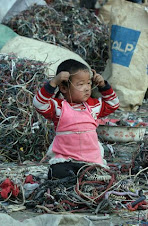
Electronic waste boyYoung Boy Against Mountain of E-Waste
Photo credit: Kainaz AmariaDharavi, the slum immortalized in director Danny Boyle’s Oscar-winning film “Slumdog Millionaire,” is home to an estimated 800,000 people who live in an area of less than one square mile, in the center of Mumbai’s wealthy suburbs.
Open sewers and garbage heaps are common sights in Dharavi, as are the slew of tiny, concrete-walled and vividly-painted factories. These provide Mumbaikers with gold jewelry, leather goods, hand-embroidered saris, and the popular snacks known as farsaan. The crude factories often double as storage spaces and sleeping quarters for their workers.
“Dharavi is a true and living microcosm of India, where the mandates of daily survival dictate the strength and spirit of individual enterprise,” said Mumbai writer Murzban Shroff, who accompanied India-West on a recent visit to Dharavi.
“Dharavi is the alchemy of diligence that transforms waste into wealth,” said Shroff, who spent several years there while researching his collection of stories, “Breathless in Bombay,” shortlisted for the 2009 Commonwealth Prize.
Dharavi is also home to one of the largest electronic waste recycling hubs in India, and similar facilities exist throughout the country, employing an estimated 80,000 workers in what is known as the “informal sector” — the poor — who dismantle and reprocess roughly half a million tons of e-waste each year. The work is done largely by hand and without protective gear to guard against the known toxins in old electronics.
Older women do much of the segregating and cleaning of waste, while children are often on the periphery, transporting materials by bicycle or foot, and sorting through mounds of tiny components gleaned from circuit boards.
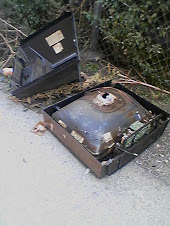
E-waste includes computers, monitors, printers, printer and ink cartridges, cell phones and old television sets. In the developing world, old electronics are mined for precious metals, such as gold, silver and copper. Recovery rates for such materials are about 40 percent, low because of the crude refining facilities.
The United Nations Environmental Program released a report in February warning developing countries that — unless they acted quickly — they would be deluged with huge mountains of e-waste. India currently produces 300,000 tons of e-waste annually and that figure is expected to jump 500 percent by the year 2020, according to the UNEP report.
The United States — which generates three million tons of e-waste annually, the largest amount in the world — sends an estimated 50,000 tons of e-waste to India, about one-tenth of all the waste the country either receives or produces itself.
India is technically barred from accepting U.S. waste by the 1989 Basel Convention Treaty, which bans the export of hazardous waste for any reason from rich to poorer countries.
But the United States is the only developed country that has not ratified the treaty and thus permits the export of most e-waste without restriction. In 2008, the General Accounting Office released a report chiding the U.S. Environmental Protection Agency for its lax oversight of e-waste exports, and recommended that the United States sign the Basel treaty.
This April, the Indian government will consider new legislation regulating electronic waste, including dismantling and recycling processes.
Interviews by India-West with more than 30 recyclers in the slum areas of Dharavi and Sakinaka in Mumbai, and Seelampur and Mandoli near Delhi, netted a trove of stories about poor working conditions, entire families sustained on wages of $2 a day, and tremendously long working hours of repetitive work.
None of the recyclers knew they were working with known toxins, or of the health risks associated with their trade. Questions about worksite-related illnesses were largely shrugged off.
E wate factoryYoung Boys Dismantle Cathode Ray Tubes
Photo credit: Som SharmaThousands of toxins exist in old equipment, including lead, lead oxide and cadmium in circuit boards, cathode ray tubes and batteries; mercury in switches and flat screen monitors; and brominated flame retardants.
Lead exposure causes brain damage in children and has already been banned from many consumer products. Mercury is toxic in very low doses, causing brain and kidney damage. Cadmium accumulates in the human body and poisons the kidneys, while brominated flame retardants may seriously affect hormonal functions critical in normal development.
Printed circuit boards, which are burned over open flames after their precious metals are extracted, release brominated flame retardants, mercury and isocyanates from the varnish, which are completely invisible and without smell, so that workers have no way of knowing they have been exposed.
The All India Institute of Medical Sciences recently conducted a study of e-waste recyclers’ exposure to lead. The study was inconclusive.
“Health impacts are very difficult to assess in the urban poor,” Ravi Agarwal, director of New Delhi-based Toxics Link, told India-West. “Methodologically, it becomes impossible to isolate exposure.”
The urban poor do have higher rates of tuberculosis and other respiratory diseases, as well as cancer, which often goes undetected, he said, adding, “Just putting a face mask on would cut down on respiratory diseases about 45 percent,” said Agarwal.
Accidents happen frequently in metal processing factories, said D.R. Dhaman, who with his brother M.K. Sharma, owns Master Industries in Shadra, near Delhi, and buys recycled copper and plastic to manufacture PVC cables for the Delhi municipality.
“We see accidents at least once a month, but they are often concealed,” he noted, adding that factory managers were often lax about the safety and health of their workers. Asked if buyers of such materials could intervene, Dhaman shrugged. “If the factory owners don’t care, why should we?” he said.
Much of the U.S. e-waste that ends up in India is collected through municipal e-waste recycling drives, and then sold to brokers, who buy the waste from cash-strapped towns and cities, and then sell it overseas. Many shipments also arrive as donations for schools. These are sold to dealers for recycling or reselling.
Shipments from the United States can change ownership while on the sea, with the port of origin on the paperwork subsequently becoming Dubai, Saudi Arabia, Hong Kong or Singapore. Such a practice makes it difficult to track U.S. shipments, explained Agarwal.
In a tiny workshop down a narrow alley in Seelampur, Delhi, Gulfam processes cathode ray tubes, from old monitors and television sets, collected throughout Delhi by kabadiwallahs. The tubes are then refurbished into new televisions that are sold to the poor for about $50, a fraction of the price for a new TV set.
“We can stick any label you like on it: Sony, Toshiba, whatever you want,” said an ebullient Gulfam, noting that a “new” set can be made in as little as five days. About 70 percent of the CRTs he receives can be refurbished, said Gulfam, adding that he throws the rest away in an undisclosed spot.
The U.S. Environmental Protection Agency regulates the export of CRTs, which contain an average of 1.5 lbs of lead. But the CRT rule is often circumvented, noted the GAO in its 2008 report, In an investigation in which its agents posed as foreign buyers, the GAO found 43 U.S. companies willing to export CRTs in violation of the EPA’s rules.
Lead has already been banned from most consumer products. CRTs are banned from U.S. landfills, due to concerns about possible lead leaching into the soil.
In several factories in Mandoli, workers melt down copper and aluminum into bars and rods that will be used elsewhere.
This reporter’s throat immediately seized up upon entering one such facility, where a gaping hole in the roof serves as the only ventilation. The young Suraj, tending one of three fires, laughed when asked whether he was affected by the smoky, sooty environment.
“You are new, so it is bothering you, but we are not bothered, we are healthy,” he told India-West, noting that he had worked there for more than five years. Only one worker, Rohit, who looked no more than 17, used a scarf over his face as he stoked the fires.
The lone woman at that factory, Lalitha, is the mother of three, who said she worked at the refinery during each of her pregnancies.
Wandering around Mandoli’s factories required wading through large pools of standing water – later discovered to be the remains of acid baths used to leach precious metals from printed circuit boards. Large piles of gray ash, the remnants of burned circuit boards, were also seen lying on the ground outside several brick-walled factories.
Journalist Kalpana Sharma, author of the seminal book “Rediscovering Dharavi,” said she is awed by the entrepreneurial spirit here.
“They actually manage very well without any help from the state. You have to admire that spirit and also wonder about what more they would be able to do if they did have access to resources,” she said.
India-West staff reporter Sunita Sohrabji received a fellowship from the Washington, D.C.-based International Center for Journalists to report this story. A longer version of this article appears in the print edition of India-West.
Friday, March 19, 2010
ANOTHER REASON WHY THE INTERNET ISN'T GREEN
from the independent
March 17, 2010
Internet trade driving rare salamander to extinction
By Michael McCarthy, Environment Editor and Kevin Rawlinson
Plight of Kaiser's spotted newt highlights new threat to wildlife
A rare salamander is being driven to the brink of extinction in the wild because of internet trading, conservationists say.
The little-known Kaiser's spotted newt, found only in Iran, is thought to be the first creature to face the threat of extinction from e-commerce - a growing threat to endangered wildlife which authorities are struggling to address. Because Neurergus kaiseri is very attractively coloured, and also rare, amphibian enthusiasts are willing to pay as much as £200 for one. Dealers can often only find people willing to pay such a price by advertising on the internet.
An investigation into the sale of Kaiser's spotted newts by the wildlife trade monitoring agency Traffic found 10 websites claiming to stock the species, including a Ukrainian company which said it had sold more than 200 wild-caught specimens in a year.
The demand has been such that the wild population, found only in four streams of Iran's Zagros Mountains, was reduced by 80 per cent between 2001 and 2005 alone, and is now classed as critically endangered. It is estimated that fewer than 1,000 mature individuals remain.
Conservationists want all international trade in wild-caught Kaiser's spotted newts made illegal. A proposal to ban such trade has been put forward by Iran at the conference of the Convention on International Trade in Endangered Species (Cites), in Doha in the Arabian gulf.
"The internet itself isn't the threat, but it's another way to market the product," said Ernie Cooper, of Traffic Canada. "The Kaiser's spotted newt, for example, is expensive and most people are not willing to pay $300 for a salamander. But through the power of the internet, tapping into global market, you can find buyers."
Kaiser's spotted newts were being advertised for sale on numerous websites yesterday, but the animals did not appear to be wild-caught. Babies were being offered for £40 each for delivery anywhere in Europe, with North American sellers asking for around twice that price including free next-day shipping. Some sellers claimed their salamanders had been captive-bred in 2008.
Illegal wildlife trade is gaining ground on the internet, according to Cites. Officials say that while wildlife law enforcement has made gains in policing physical markets for wildlife, the online world - with its "virtual" markets that have yet to be properly regulated - presents a set of new challenges.
Over the next few days, the 175 Cites member states meeting in Doha, including Britain, will consider whether to take a more proactive approach to regulating the online trade in endangered species. This is likely to include the creation of an international database, scientific research to gauge the correlation between wildlife loss and online trade, and closer collaboration with Interpol, the international law enforcement agency.
Subscribe to:
Posts (Atom)






 Posts


