America’s Biggest Trade Export to China? Trash
March 03, 2010 02:58 PM ET
By Jodie Allen, Thomas Jefferson Street blog
It has come to the attention of a growing number of expert observers that the good old USA may have seen its best days on the world stage. But these critics may be overlooking a potential way for America to continue to play at least a major supporting part--if not an especially decorous one--in the world economic drama.
The nation now cast in the role of Eve Harrington to America's Margo Channing is, of course, China. China's economic strength continues to make headlines. Most recently: its overtake of Germany as the world's largest goods exporter last year; its fast rebound to a 10.7 percent growth rate in the 2009 fourth quarter; its projected ascent this year to the No. 2 position among world economies, displacing Japan.
It's gotten so that even the normally chest-thumping American public is feeling a bit insecure. A Pew Research Center/Council on Foreign Relations poll conducted last fall found 4 in 10 (41 percent) among the public saying the United States plays a less important and powerful role as a world leader today than it did 10 years ago--the highest proportion ever recorded in a Pew Research survey across the years. More to the point, by a 44 percent-27 percent margin, Americans now name China as the world's leading economic power rather than the United States. As recently as February 2008, 41 percent still saw the United States as the top economic power compared with 30 percent who named China.
Add to this the mounting worry about the exporting of American jobs--not just among displaced workers but now even among mainstream economists--and you can see why Mike Mokrzycki of the ABC News Polling Unit sums up his organization's new survey thusly: " 'The 'American Century' was sooo last century, as many Americans see it." The ABC survey shows the public evenly split, 41 percent-40 percent, on whether it will be a Chinese or American century in terms of economic power, and giving a slight 43 percent-38 percent edge to China when it comes to a dominant role in world affairs.
But perhaps there is some room for optimism on the trade front. True, the shrinking of the U.S. trade deficit over much of last year mostly reflected the restricted diet of foreign imports forced upon U.S. consumers by the recession, and its recent resurgence has been viewed as a positive sign of a rebound. But another little-noticed factor was apparently also at work.
As the Wall Street Journal noted in reporting the resurgence of the trade deficit last November, while the U.S. shortfall with most other major trading partners increased, the deficit with China actually declined. The Journal didn't analyze the components of the shrinkage, but an intriguing table in a recent, little-noticed report to Congress by the U.S.-China Economic and Security Review Commission points to one interesting trend.
The report itself focuses on data in the chart showing a 454 percent surge in Chinese exports of computer equipment to the United States over the 2000-2008 period and an even larger 800 percent rise in communications equipment exports as clear evidence that "China's industrial policy clearly aims to promote the manufacturing of higher-technology products, replacing lower value-added and labor-intensive products."
No doubt. But the report draws no attention to the components of a relatively recent surge in U.S. exports to China, perhaps the result of growing American concern about its mammoth trade imbalance with the Middle Kingdom. Between 2004 and 2008, these exports more than doubled from $34.7 billion to $71.5 billion, far short of the $337.8 billion the U.S. imported from China in 2008, but still a step in the right direction.
And while electronic components as well as oilseeds and grain continue to rank among the top three categories of exported goods, the fastest growing and now No. 1 export category is--"Scrap and Trash."
According to data provided by the U.S. International Trade Commission, Chinese imports of U.S. cast-offs (scrap metal, waste paper, and the like) surged by an eye-popping 916 percent over the 2000-2008 period, with most of that expansion occurring after 2004.
Perhaps not many observers will judge this a suitably glamorous role for America to assume on the global stage. But one might take comfort in the thought that if there is one thing that Americans still excel at producing, it's trash.
Wednesday, March 3, 2010


Monday, March 1, 2010
BASEL ACTION NETWORK STORY
INDONESIA TURNS BACK ILLEGAL SHIPMENT OF E-WASTE
FROM USA "RECYCLER"
TIP COMES FROM U.S. WATCHDOG AS E.P.A. FAILS TO ACT
Seattle, Washington (1 March 2010). The Basel Action Network (BAN), an environmental watchdog organization, reported today that it had successfully prevented nine sea-going containers of hazardous electronic waste from a Massachusetts business calling themselves a recycler from being exported and delivered to Indonesia in contravention of the international treaty on hazardous waste known as the Basel Convention and Indonesian law. The action was made possible due to a tip by BAN to the Ministry of Environment in Indonesia. Last week in Bali, Indonesia, representatives from BAN and Asian environmental groups met with and personally thanked the Minister of Environment and the Indonesian authorities responsible for this police action, which comes just as the United Nations Environment Program released a report highlighting the massive amounts of e-waste flooding developing countries in contravention of the Basel Convention.
“Indonesia is just one of many countries now being flooded by a tsunami of toxic electronic waste from the United States,” said Jim Puckett, Executive Director of the Basel Action Network. “Even though our own government knows that the importation of toxic waste from the US is a violation of the laws of most countries of the world, our own EPA shamefully allows the global dumping to continue.”
In this case, the perpetrator of the shipment, CRT Recycling Inc. in Brockton, Massachusetts, utilized a waste broker, Advanced Global Technologies Inc., that is listed on an official EPA website as being an EPA registered e-waste exporter. In 2008, the Government Accountability Office slammed the EPA for doing far too little to control exports of electronic waste from the United States, but still little has changed as there remains no law sufficient to control the flood of toxic e-waste. It is estimated by Hong Kong authorities that 50-100 containers of e-waste enter the port of Hong Kong alone each day. Almost all of this comes from the United States according to BAN.
BAN, together with the Electronic TakeBack Coalition, has been campaigning for a new law prohibiting hazardous e-waste exports from the United States, a ban already in place in 32 other developed countries. In 2008, BAN assisted CBS’s 60 Minutes to track containers from a similar Colorado based recycler to China. Since 2001, BAN has travelled the world revealing the cyber-age nightmare of e-waste exports and dumping in developing countries (see photo gallery at: http://www.ban.org/photogallery/index.html)
In this case, BAN volunteers staked out CRT Recycling Incorporated in Brockton, Massachusetts, a company that takes thousands of monitors every year from local schools and governments who unwittingly believe their old computers and monitors will legally and properly recycled. BAN photographed a container in the CRT Recycling, Inc. yard being loaded with cathode ray tube (CRT) computer monitors. Using container numbers and online shipping company databases, they were able to track the container and its ship to the port of Semarang, Indonesia. In November of 2009, BAN contacted the Indonesian Ministry of Environment and warned them of the ship’s imminent arrival and the hazardous wastes it carried.
Indonesian authorities then seized the container and found it to be part of a consignment of 9 such containers coming from CRT Recycling, Inc. These were opened and confirmed to be stacked full of untested, used computer monitors -- each containing several pounds of lead and other hazardous substances -- thus making them an internationally defined hazardous waste and therefore illegal to import into Indonesia. All 9 containers were then returned to the US. The containers arrived in Boston port in early February and are currently thought to be detained at the Boston Freight Terminal with a deadline to clear customs by February 28th. CRT Recycling, Inc. has stated that they will turn the CRTs over to RMG Enterprises, of Londonderry, New Hampshire, for further processing. The EPA is expected to inspect the containers upon arrival.
However it is unlikely that CRT Recycling, Inc. or its broker, Advanced Global Technologies Inc., will be prosecuted for illegal hazardous waste exportation as the United States has never ratified the Basel Convention, and the only current law on the subject, known as “the CRT Rule,” is riddled with loopholes allowing uncontrolled exports. In fact, on EPA’s CRT rule website (see http://www.epa.gov/osw/hazard/international/crts/reuse.htm), Advanced Global Technologies Inc. is listed as an EPA officially sanctioned waste exporter.
According to BAN, about 80 percent of the e-waste consumers deliver to recyclers is not recycled by these companies at all but is simply shipped to countries in Asia and Africa to some of the world’s most impoverished communities where the waste is smashed, burned, melted or chemically treated in extremely dangerous backyard operations. BAN warns businesses and consumers to hand over their old electronic equipment only to designated e-Stewards® Recyclers that have been carefully screened and audited to ensure they do not export, use prison labor, or dump toxics in municipal landfills and incinerators.
“Consumers can take action to prevent techno-trash dumping,” said Puckett. “We must urge Congress to pass a prohibition on waste exportation at once, and we must vow to never deliver old computers and TVs to any company that is not a designated e-Stewards Recycler.”
Sunday, February 28, 2010
Friday, February 26, 2010
ENVIRONMENT NEWS UPDATE
Smart Centers Planned to Recycle Mountains of Toxic E-Waste
NUSA DUA, Bali, Indonesia, February 23, 2010 (ENS) - To safely manage the floods of obsolete electronics headed their way, developing countries need to establish e-waste management centers of excellence, the United Nations Environment Programme advises in a report released Monday.
Sales of electronic products in China and India and across Africa and Latin America are set to rise sharply in the next 10 years, according to UN experts in the report. Unless environmentally sound actions are taken to collect and recycle materials, many developing countries will face mountains of old computers, printers, mobile phones, pagers, digital photo and music devices, refrigerators, toys and televisions with serious consequences for the environment and public health.
Mountain of discarded electronics in Guiyu, China, one of the biggest e-waste centers of the world. (Photo by Bert van Dijk)
Electronics contain up to 60 different elements, many valuable, some hazardous, and some both. The report advises that if centers of recycling excellence are set up, obsolete electronics that contain valuable metals such as silver, gold, palladium, copper and indium can be harvested while creating recycling jobs.
Said Konrad Osterwalder, rector of United Nations University, which co-authored the report, "One person's waste can be another's raw material. The challenge of dealing with e-waste represents an important step in the transition to a green economy."
"This report outlines smart new technologies and mechanisms which, combined with national and international policies, can transform waste into assets, creating new businesses with decent green jobs," said Osterwalder. "In the process, countries can help cut pollution linked with mining and manufacturing, and with the disposal of old devices."
The idea of mountains of e-waste is no exaggeration. Global e-waste generation is growing by about 40 million tons a year, the report states. Globally, more than one billion mobile phones were sold in 2007, up from 896 million in 2006.
In the United States, more than 150 million mobile phones and pagers were sold in 2008, up from 90 million five years before.
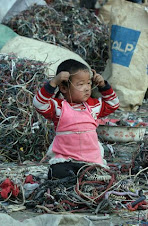
Chinese girl holds a discarded keyboard, part of a mountain of e-waste that landed in her village. (Photo courtesy Greenpeace)
Manufacturing mobile phones and personal computers consumes three percent of the gold and silver mined worldwide each year; 13 percent of the palladium and 15 percent of cobalt.
The report finds that carbon dioxide emissions from the mining and production of copper and precious and rare metals used in electrical and electronic equipment are estimated at over 23 million tonnes - one-tenth of a percent of global emissions. This figure does not include CO2 emissions linked to steel, nickel or aluminum, nor those linked to manufacturing the devices.
"Recycling - from E-Waste to Resources," used data from 11 developing countries to estimate current and future e-waste generation.
In South Africa and China for example, the report predicts that by 2020 e-waste from old computers will have jumped by 200 to 400 percent from 2007 levels, and by 500 percent in India.
By 2020 in China, e-waste from discarded mobile phones will be about seven times higher than 2007 levels and, in India, 18 times higher.
By 2020, e-waste from televisions will be 1.5 to 2 times higher in China and India while in India e-waste from discarded refrigerators will double or triple.
In a Chinese village, this man burns plastic circuit boards to recover the precious metals, releasing toxic smoke. (Photo courtesy StEP-EMPA)
China already produces about 2.3 million tonnes domestically, second only to the United States with about three million tonnes. And, despite having banned e-waste imports, China remains a major e-waste dumping ground for developed countries.
Most e-waste in China is improperly handled, much of it incinerated by backyard recyclers to recover the gold, but these informal practices release plumes of toxic pollution and yield very low metal recovery rates compared to state-of-the-art industrial facilities, this report and past investigations have found.
"This report gives new urgency to establishing ambitious, formal and regulated processes for collecting and managing e-waste via the setting up of large, efficient facilities in China," says UNEP Executive Director Achim Steiner.
"China is not alone in facing a serious challenge," he said. "India, Brazil, Mexico and others may also face rising environmental damage and health problems if e-waste recycling is left to the vagaries of the informal sector."
The report was issued at a meeting of world chemical authorities prior to UNEP's Governing Council meeting in Bali, Indonesia, which opens Wednesday.
The meeting brings together the Parties to three treaties - the Basel, Rotterdam and Stockholm Conventions - that are working to enhance their cooperation and coordinate their activities.
The Basel Convention on the Control of Transboundary Movements of Hazardous Wastes and their Disposal is the most comprehensive global environmental agreement on hazardous and other wastes and has 172 government Parties. In 2008, Parties adopted guidelines on collecting and refurbishing used mobile phones and the recovery and recycling their components at end-of-life.
The Rotterdam Convention covers 40 pesticides and industrial chemicals that have been banned or severely restricted for health or environmental reasons by the Parties.
The Stockholm Convention on Persistent Organic Pollutants protects human health and the environment from chemicals that remain intact in the environment for long periods, become widely distributed geographically, accumulate in the fatty tissue of living organisms and are toxic to humans and wildlife.
Finding a way forward will be challenging, the report concludes. Developing vibrant national recycling schemes is complex and simply financing and transferring high tech equipment from developed countries is unlikely to work, according to the report.
A modern e-waste dismantling-component recycling factory in China (Photo courtesy StEP-UNU)
It says China's lack of a comprehensive e-waste collection network, combined with competition from the lower-cost informal sector, has held back state-of-the art e-waste recycling plants.
It notes a successful pilot in Bangalore, India to transform the operations of informal e-waste collection and management.
Brazil, Colombia, Mexico, Morocco and South Africa are cited as places with great potential to introduce state of the art e-waste recycling technologies because the informal e-waste sector is relatively small.
Kenya, Peru, Senegal and Uganda have relatively low e-waste volumes today but these volumes are likely to grow. All four countries would benefit from capacity building in so-called pre-processing technologies such as manual dismantling of e-waste.
The report recommends countries establish e-waste management centers of excellence, building on existing organizations, including the more than 40 National Cleaner Production Centers established by the UN Industrial and Development Organization and the regional centers established under the Basel Convention.
The report was co-authored by EMPA, the research institute for material science and technology of the Swiss Federal Institute of Technology, a pioneer in monitoring and controlling for e-waste management systems and setting recycling and disposal standards.
Another co-author was Umicore, an international speciality materials group with a state-of-the-art integrated metals smelter and refinery at Hoboken, Belgium where precious metals as well as base and special metals are recovered and brought back to the market as pure metals.
EMPA and Umicore are part of the StEP Initiative, Solving the E-Waste Problem, a think tank hosted by UNU in Bonn, Germany. StEP's more than 50 members include UNEP and the Basel Convention Secretariat, industry, government and international organizations, NGOs and the science sector.
A grant from the European Commission Directorate-General for the Environment funded the report's preparation.
Monday, February 22, 2010
CRUCIAL NEW UN REPORT
IS GETTING LOADS OF PUBLICITY--check local listings, as the saying goes
Urgent Need to Prepare Developing Countries for Surge in E-Wastes
Rocketing sales of cell phones, gadgets, appliances in China, India, elsewhere forecast
Proper e-waste collection, recycling key to recovering valuable materials, protecting health, building new green economy
Bali, 22 February 2010 - Sales of electronic products in countries like China and India and across continents such as Africa and Latin America are set to rise sharply in the next 10 years.
And, unless action is stepped up to properly collect and recycle materials, many developing countries face the spectre of hazardous e-waste mountains with serious consequences for the environment and public health, according to UN experts in a landmark report released today by UNEP.
Issued at a meeting of Basel Convention and other world chemical authorities prior to UNEP's Governing Council meeting in Bali, Indonesia, the report, "Recycling - from E-Waste to Resources," used data from 11 representative developing countries to estimate current and future e-waste generation - which includes old and dilapidated desk and laptop computers, printers, mobile phones, pagers, digital photo and music devices, refrigerators, toys and televisions.
In South Africa and China for example, the report predicts that by 2020 e-waste from old computers will have jumped by 200 to 400 percent from 2007 levels, and by 500% in India
By that same year in China, e-waste from discarded mobile phones will be about 7 times higher than 2007 levels and, in India, 18 times higher.
By 2020, e-waste from televisions will be 1.5 to 2 times higher in China and India while in India e-waste from discarded refrigerators will double or triple.
China already produces about 2.3 million tonnes (2010 estimate) domestically, second only to the United States with about 3 million tonnes. And, despite having banned e-waste imports, China remains a major e-waste dumping ground for developed countries.
Moreover, most e-waste in China is improperly handled, much of it incinerated by backyard recyclers to recover valuable metals like gold - practices that release steady plumes of far-reaching toxic pollution and yield very low metal recovery rates compared to state-of-the-art industrial facilities.
"This report gives new urgency to establishing ambitious, formal and regulated processes for collecting and managing e-waste via the setting up of large, efficient facilities in China," says UN Under-Secretary-General Achim Steiner, Executive Director of UNEP. "China is not alone in facing a serious challenge. India, Brazil, Mexico and others may also face rising environmental damage and health problems if e-waste recycling is left to the vagaries of the informal sector.
"In addition to curbing health problems, boosting developing country e-waste recycling rates can have the potential to generate decent employment, cut greenhouse gas emissions and recover a wide range of valuable metals including silver, gold, palladium, copper and indium - by acting now and planning forward many countries can turn an e-challenge into an e-opportunity," he added.
The report was issued at the Simultaneous Extraordinary Meetings of the Conferences of the Parties to the Basel, Rotterdam and Stockholm Conventions on enhancing their cooperation and coordination (ExCOP).
It was co-authored by the Swiss EMPA, Umicore and United Nations University (UNU), part of the global think tank StEP (Solving the E-waste Problem), which includes UNEP and Basel Convention Secretariat among its 50+ members. Hosted by UNU in Bonn, Germany, the think tank convenes experts from industry, government, international organizations, NGOs and science. A grant from the European Commission, Directorate-General for the Environment, funded the report's preparation.
The report cites a variety of sources to illustrate growth of the e-waste problem:
* Global e-waste generation is growing by about 40 million tons a year
* Manufacturing mobile phones and personal computers consumes 3 per cent of the gold and silver mined worldwide each year; 13 per cent of the palladium and 15 per cent of cobalt
* Modern electronics contain up to 60 different elements - many valuable, some hazardous, and some both
* Carbon dioxide emissions from the mining and production of copper and precious and rare metals used in electrical and electronic equipment are estimated at over 23 million tonnes - 0.1 percent of global emissions (not including emissions linked to steel, nickel or aluminum, nor those linked to manufacturing the devices)
* In the US, more than 150 million mobiles and pagers were sold in 2008, up from 90 million five years before
* Globally, more than 1 billion mobile phones were sold in 2007, up from 896 million in 2006
* Countries like Senegal and Uganda can expect e-waste flows from PCs alone to increase 4 to 8-fold by 2020.
* Given the infrastructure expense and technology skills required to create proper facilities for efficient and environmentally sound metal recovery, the report suggests facilitating exports of critical e-scrap fractions like circuit boards or btteries from smaller countries to OECD-level, certified end-processors.
Says Konrad Osterwalder, UN Under-Secretary General and Rector of UNU: "One person's waste can be another's raw material. The challenge of dealing with e-waste represents an important step in the transition to a green economy. This report outlines smart new technologies and mechanisms which, combined with national and international policies, can transform waste into assets, creating new businesses with decent green jobs. In the process, countries can help cut pollution linked with mining and manufacturing, and with the disposal of old devices."
Country Situations
The report assesses current policies, skills, waste collection networks and informal recycling in 11 representative developing economies in Asia, Africa and the Americas:
* China, India
* South Africa, Uganda, Senegal, Kenya, Morocco
* Brazil, Columbia, Mexico, Peru
It also outlines options for sustainable e-waste management in those countries.
The data includes equipment generated nationally but does not include waste imports, both legal and illegal, which are substantial in India, China and other emerging economies.
Broken down by type, the report estimates e-waste generation today as follows:
* China: 500,000 tonnes from refrigerators, 1.3 million tonnes from TVs, 300,000 tonnes from personal computers
* India: over 100,000 tonnes from refrigerators, 275,000 tonnes from TVs, 56,300 tonnes from personal computers, 4,700 tonnes from printers and 1,700 tonnes from mobile phones
* Colombia: about 9,000 tonnes from refrigerators, over 18,000 tonnes from TVs, 6,500 tonnes from personal computers, 1,300 tonnes from printers, 1,200 tonnes from mobile phones
* Kenya: 11,400 tonnes from refrigerators, 2,800 tonnes from TVs, 2,500 tonnes from personal computers, 500 tonnes from printers, 150 tonnes from mobile phones
The report also includes data on per capita sales of electrical and electronic goods. For example South Africa and Mexico lead in personal computer sales with the equivalent of 24 sold per 1,000 people. Brazil, Mexico and Senegal generate more e-waste per capita from personal computers than the other countries surveyed.
Way Forward
Developing vibrant national recycling schemes is complex and simply financing and transferring high tech equipment from developed countries is unlikely to work, according to the report.
It says China's lack of a comprehensive e-waste collection network, combined with competition from the lower-cost informal sector, has held back state-of-the art e-waste recycling plants.
It also notes a successful pilot in Bangalore, India, to transform the operations of informal e-waste collection and management.
Brazil, Colombia, Mexico, Morocco and South Africa are cited as places with great potential to introduce state of the art e-waste recycling technologies because the informal e-waste sector is relatively small.
Kenya, Peru, Senegal and Uganda have relatively low e-waste volumes today but likely to grow. All four would benefit from capacity building in so-called pre-processing technologies such as manual dismantling of e-waste.
The report recommends countries establish e-waste management centers of excellence, building on existing organizations working in the area of recycling and waste management.
Existing bodies include those supported by the United Nations including the more than 40 National Cleaner Production Centers established by the UN Industrial and Development Organization and the regional centers established under the Basel Convention on the Control of Transboundary Movements of Hazardous Wastes and their Disposal.
* * * * *
Basel Convention (www.basel.int)
Joining Mr. Steiner at the Bali news conference, Katharina Kummer, Executive Secretary of the Basel Convention on the Control of Transboundary Movements of Hazardous Wastes and their Disposal, noted complementary actions by her organization.
In 2008, Parties to the Convention adopted guidelines on collecting and refurbishing used mobile phones and the recovery and recycling their components at end-of-life, developed under the 2003 Mobile Phone Partnership Initiative (MPPI).
In Africa, with funding from the European Commission, UK, Norway and the Dutch Recyclers Association, e-waste inventories and national management plans are being developed, alongside national pilot projects to establish collection, repair, refurbishment and recovery systems. Similar effort in the Asia Pacific region are in development with financial support from Japan.
Bali also hosted the launch two years ago of the Partnership for Action on Computing Equipment, of which StEP is a member. PACE is developing guidelines on refurbishing used computers and recycling end-of-life equipment. Some 35 developing countries and countries with economies in transition have expressed interest in pilot projects in development on the collection and environmentally sound management of e-waste in the informal sector.
United Nations University (www.unu.edu)
UNU is an autonomous organ of the UN General Assembly dedicated to generating and transferring knowledge and strengthening capacities relevant to global issues of human security, development, and welfare. The University operates through a worldwide network of research and training centres and programmes, coordinated by UNU Centre in Tokyo.
StEP (www.step-initiative.org)
Hosted by UNU in Germany, Solving the E-Waste Problem is a partnership of several UN organizations, prominent industry, government and international organizations, NGOs and the science sector. StEP initiates and facilitates sustainable e-waste handling through analysis, planning and pilot projects. Earlier this month, StEP and the Basel Convention's PACE organization, agreed to further strengthen cooperation and harmonization of global e-waste related activities.
EMPA (www.empa.ch)
EMPA is the research institute for material science and technology of the Swiss Federal Institute of Technology (ETH) domain. It is a pioneer in monitoring and controlling for e-waste management systems and setting recycling and disposal standards. Empa is also leading several e-waste related projects in Asia, Africa and Latin America. Additionally, it manages the online e-waste guide (www.ewasteguide.info), a comprehensive resource base on e-waste including a bibliography of literature, case studies, audio and video files and other information on e-waste.
Umicore (www.umicore.com)
Umicore is an international speciality materials group. It's business unit Umicore Precious Metals Refining offers eco-efficient recycling services for electronic scrap and other valuable metal bearing materials to a global customer base. In its state-of-the-art integrated metals smelter and refinery at Hoboken/Belgium precious metals as well as base and special metals are recovered and brought back to the market as pure metals.
For more information please contact:
Nick Nuttall, UNEP Spokesperson/Head of Media, Nairobi, + 254-20-7623084; + 254-733-632755 (m); +41-79-596-5737 (m2), e-mail: nick.nuttall@unep.org
Moira O'Brien-Malone, UNEP Information Officer, Division of Technology, Industry and Economics (DTIE), Paris, + 33-1-4437-7612, moira.obrien-malone@unep.org
Jim Sniffen, UNEP Programme Officer, New York, +1-212-963-8094 or 8210 info@nyo.unep.org
Terry Collins, +1-416-538-8712; +1-416-878-8712 (m); tc@tca.tc
Tuesday, February 9, 2010
NRDC NEWS
NRDC Endorses New Certification for Safe, Ethical Electronic Waste Recycling
e-Steward® Recyclers Will Not Dump your e-Waste in Developing Countries
WASHINGTON - February 9 - The Natural Resources Defense Council (NRDC) today announced its endorsement of the first-ever certification program for electronics recycling created jointly by the environmental community and business leaders. The new e-Stewards Certification and Standard, held by the Basel Action Network (BAN), is seen as essential to stem the tide of hazardous old computers, TVs, monitors and other electronic waste currently flooding African and Asian countries such as Ghana, Nigeria, India, Pakistan and China.
Today, NRDC joins with BAN to call on all electronics recyclers to become e-Steward Certified recyclers and, secondly, asks all businesses to become designated "e-Steward Enterprises" by agreeing to give priority to e-Steward recyclers for their old electronic assets. "This initiative is sorely needed," said NRDC Senior Scientist Dr. Allen Hershkowitz. "Many e-waste recyclers claim to be green, but in reality they rely on unsafe and ecologically damaging methods like dumping millions of tons of toxic waste each year in China, India and Africa. E-Stewards provide businesses and consumers with a first-of-a-kind seal to identify the truly responsible recyclers." In 2008, the Government Accountability Office (GAO) released a report roundly criticizing the US EPA for not doing more to promulgate and enforce rules to control the e-waste trade. Unfortunately, to date little has changed and a market-based solution is seen as more necessary than ever.
The e-Steward Certification is a fully accredited certification that relies on independent, third-party auditors to verify safe and ethical e-waste disposal. It is awarded to companies that recycle electronics without using practices that far too many in U.S. electronics recycling industry rely upon - the use of municipal landfills and incinerators, the export to developing countries, or US prison labor for disposing of toxic old electronics.
Businesses that agree to make best efforts to use e-Steward recyclers will be rewarded as designated e-Stewards Enterprises. The first global companies to receive these e-Steward Enterprise designations as well as the first Certified e-Steward recyclers will be announced in March. Already there are about 50 North American recyclers that are considered "Pledged e-Stewards" which have been vetted by BAN and are licensed and committed to becoming certified in the next 18 months. These companies include some of the largest electronics recyclers in North America. For a complete list, go to: http://www.e-stewards.org/local_estewards.html [4]. Due to the widespread fraudulent or unscrupulous exportation and irresponsible practices now plaguing the electronics recycling industry, consumers are urged to use only these Pledged e-Steward recyclers.
"NRDC recognized that we have finally created a principled yet practical solution to e-waste recycling that environmentalists, businesses and consumers can all embrace," said Jim Puckett, Executive Director of the Basel Action Network. "We are thrilled to receive NRDC's coveted endorsement in the lead up to our global launch."
For more information visit: www.e-stewards.org
Subscribe to:
Posts (Atom)





 Posts


